Block Blast! Turns Spare Minutes Into a Test of Self-Control

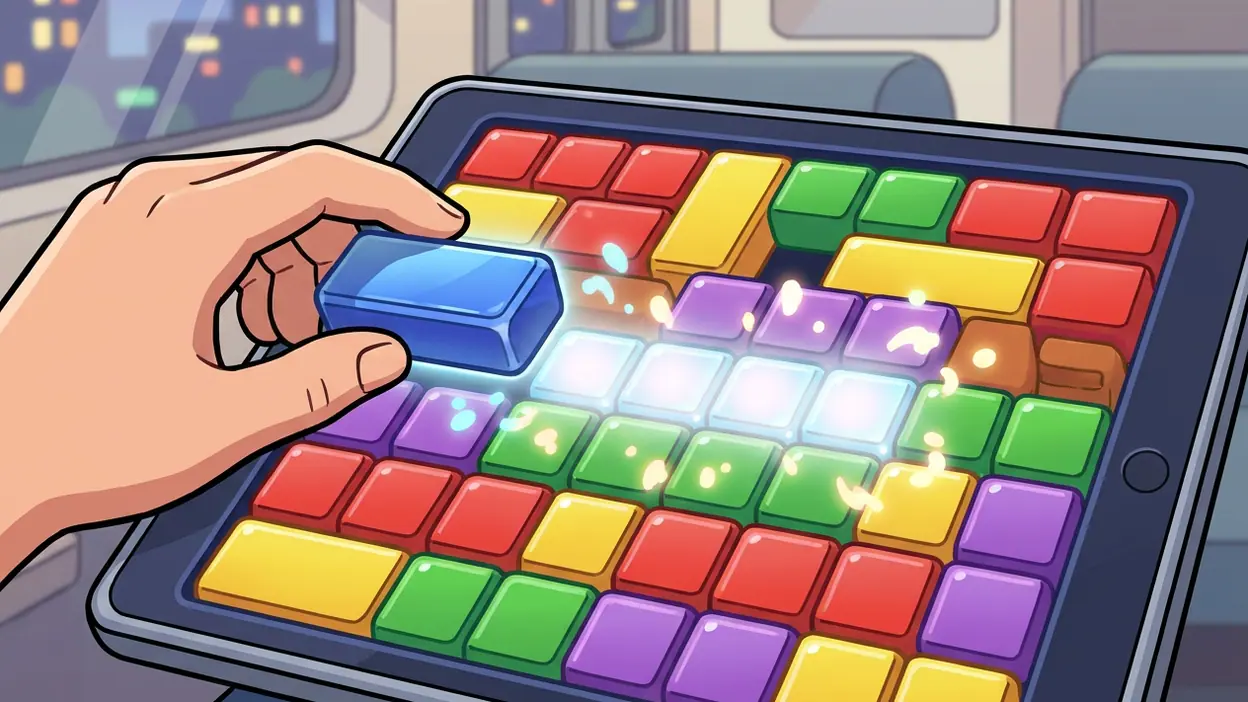
A crowded train, a waiting room, a pause before bed: the modern phone ritual often begins with a game that asks almost nothing of us. Block Blast! makes that bargain unusually clear. It gives you a clean grid, a handful of chunky shapes, and a private challenge: fit them without running out of room. Its appeal is not just that it is easy to learn. It is that it gives idle time a shape, then lets the player feel briefly in control of it.
This is a puzzle game built for the gaps in a day, but it also reflects a wider habit: reaching for a manageable task whenever attention has nowhere obvious to go. The board is small enough to understand at a glance and open-ended enough to keep inviting another move. That combination turns a simple block puzzle into a pocket-sized ritual, one that feels calming until a careless placement makes the whole board look suddenly fragile.

Block Blast!
HungryStudio4.8Puzzle
See More Apps Related to Block Blast!


A small game for a fragmented day
The basic loop is immediate. Blocks arrive in groups, and you place them on a square board, aiming to complete full rows or columns so they clear and make space again. There is no opponent to watch, no elaborate world to learn, and no long tutorial separating a new player from the first decision. You can begin in seconds, which is exactly why the game fits into the little intervals that phones have trained us to notice.
Yet the simplicity is not the same as mindlessness. Each set of shapes asks you to weigh what fits now against what could become useful later. A long bar may be easy to place but dangerous to postpone; a compact piece can patch a gap while leaving awkward holes behind. The best move is often not the one that clears the most immediately. It is the one that leaves the board flexible enough for whatever comes next.
That makes the game a modest counterpoint to feeds that keep changing the subject for you. Here, attention stays in one place. You study a fixed grid, test a possibility, and live with the result. The session may last only a minute, but it has a beginning, a middle, and a clear condition for failure. In a phone culture full of endless streams, that sense of a bounded task has its own quiet comfort.
The visual language helps. The blocks are bright, solid, and legible, while the board stays calm enough to keep the puzzle readable. There is little to decode before acting. I found that clarity satisfying, especially in short sessions: the game does not make me hunt for the point. It puts the decision directly in front of me.
The habit of one more placement
The game normalizes a tiny, repeatable unit of focus. A move takes a moment; a session can stretch, but it never needs to. That scale suits people who check their phones between tasks rather than settling in for a long play session. The game does not demand a chair, headphones, or a remembered storyline. It slips beside ordinary life, ready to be picked up and put down.
Worth Reading Next

OpenTable’s OS Update Makes Booking Smoother, but Search Still Leads
Cash App by Use Case: Who Should Trust It With Their Money?

Clash of Clans Makes Every Raid the Start of a New Plan

Stickman Warriors Is Built for Quick Fights, Not Deep Competition

Downloader’s One-Tap Promise Comes With Real Limits
More From Our News Desk
View All


Its rhythm is the hook. A clear creates breathing room, and breathing room makes the next placement feel possible. When the board gets crowded, each new piece carries a little more weight. You begin to scan ahead, not because the game has suddenly become grand, but because the cost of a bad fit is now visible. A satisfying clear can rescue a tight board; a poor sequence can leave a stubborn pocket that refuses to accept the shapes you need.
That tension is what gives the loop its replay value. The board can look settled, then become precarious after one misplaced piece. A near miss invites the thought that the next attempt will be cleaner. The player is not chasing a complicated narrative payoff; the reward is a better run, a fuller clear, or simply the feeling of having read the board well. It is a small form of competence that can be repeated whenever there is room in the day.
There is a status signal here, though it is quieter than a leaderboard or a multiplayer match. A high score can stand as evidence of patience and pattern recognition, but the game’s more immediate reward is private: I saw the opening, I kept space, I made the right call. The experience is less about displaying skill to an audience than proving it to yourself. That modesty is part of its convenience. The game asks for attention without asking for a performance.
It also fits the phone as an object of transition. People unlock a device while waiting for coffee, riding an elevator, or sitting through a pause between messages. A puzzle that can be understood in a glance has a clear advantage in those moments. Unlike a remote-control utility such as Universal TV Remote Control, it does not solve a household problem; unlike a streaming service, it does not ask for sustained viewing. It fills a gap rather than organizing the evening.
Where the comfort turns revealing
The ritual can be genuinely pleasant. The board offers a task with visible boundaries, and each placement turns vague spare time into a sequence of choices. There is no need to explain what you are doing or coordinate with anyone else. For a person who wants a brief reset, that privacy matters. The game is available on the same device used for work, messages, maps, and chores, so the switch from obligation to play takes almost no effort.
But that ease points to a less comfortable truth about phone habits. A pause does not have to remain empty for long. It can be filled automatically, even when the person reaching for the phone is not sure what they want. Block Blast! gives that impulse a more coherent destination than a random scroll, but it still makes the spare moment available for capture. The question is not whether a short game is harmful; it is whether every unclaimed minute must become a prompt for another round.
The design mirrors this tension through its clean presentation. There is very little visual clutter between the player and the next decision, which keeps the puzzle accessible. At the same time, a tidy surface can make repetition feel frictionless. That is a strength for a game meant to be picked up quickly, but it can blur the point at which a refreshing break becomes an automatic check-in. I sometimes finished a round with no particular desire to continue, then noticed how easily the board could persuade me to try again.
That is also where the game’s limitations show. Its central idea stays consistent, so players who want changing objectives, a strong narrative, or deeper strategic systems may find the experience repetitive. The satisfaction depends heavily on whether arranging shapes and managing space is its own reward for you. A clean board and a good run can feel absorbing; a cramped board and an unlucky sequence can feel more like a slow surrender than a clever puzzle.
Other mobile products borrow the same convenience-first logic, even when their purposes differ. Anime tv - Anime Tv Online HD competes for short bursts of attention with a stream of watchable material; Play Pretend Food Menu turns a familiar activity into a quick interaction; Fantasy Realms draws people toward a more involved world. They are not direct puzzle rivals, but each depends on the phone’s promise of an immediate, self-contained experience. Block Blast! is the stripped-back version of that promise: no setting to enter, only a board to manage.
Its closest competition is not necessarily another block game. It is the phone itself: the notification that interrupts a plan, the feed that offers a new topic every second, the collection of apps that make any pause feel unfinished. Against those distractions, Block Blast! has a useful discipline. It asks the player to stay with one visual problem long enough to make a choice. The game does not eliminate fragmentation, but it gives attention a simple object to hold.
That object is why people keep it close. The rules travel well across settings, the play can be paused without losing a plot, and the board creates a clear reason to return. The experience is not deep in the conventional sense, nor does it pretend to be. Its depth comes from repetition: the same basic placement problem changes character as empty space disappears, and the player learns to anticipate the consequences of each move.
In the end, Block Blast! reads like a small portrait of how we use phones now. We want entertainment that starts instantly, fits between obligations, and rewards attention without demanding much of our identity. The game serves that appetite with unusual clarity, while quietly exposing its cost: even rest can become another loop to optimize. I like it best as a deliberate pause, not a reflex. Its board is simple, but the choice it leaves to the player is surprisingly modern: fill the moment, or let it remain open.