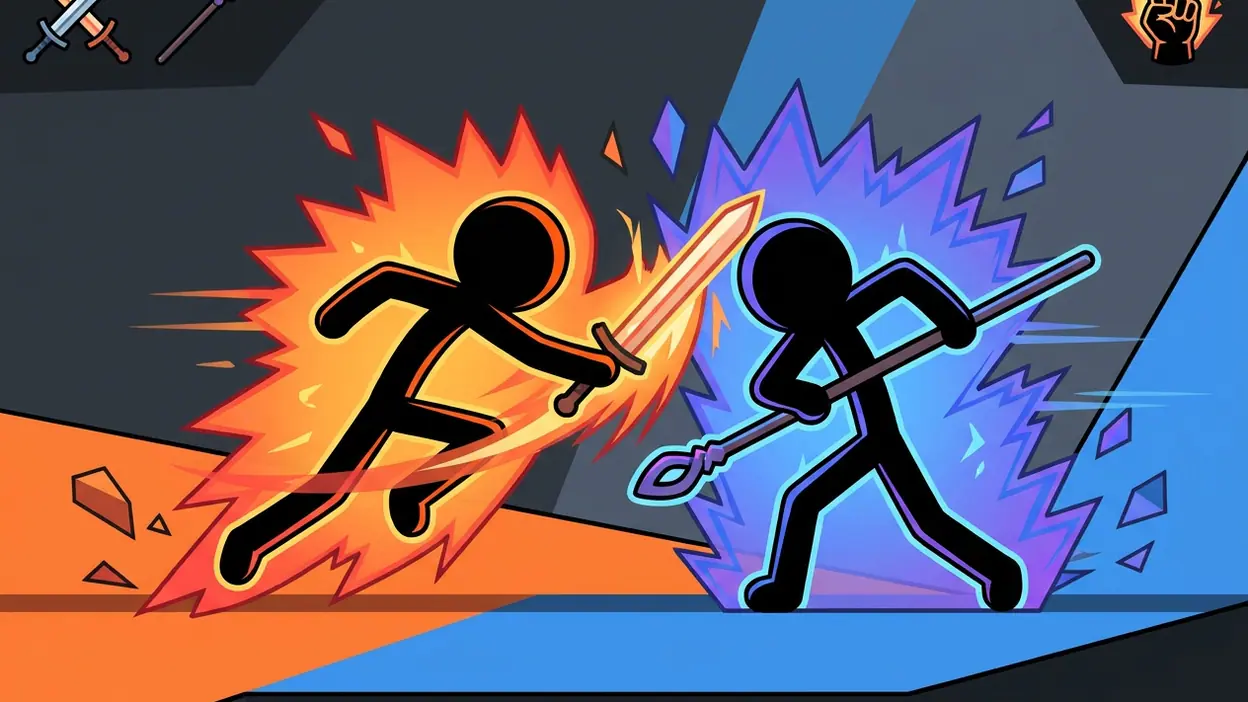
Stickman Warriors Is Built for Quick Fights, Not Deep Competition

Most mobile action games ask for a little patience before the fun arrives: learn a roster, wait through a lobby, or absorb a tutorial before the first real scrap. Stickman Warriors has a more immediate pitch. It puts simple stick-figure fighters into compact, physics-heavy duels and lets the swing of the match do the explaining. Against Aquapark.io, Pokémon UNITE, Blood Strike: 2.5 Anniversary, and Kick the Buddy: Second Kick, its case is not depth or polish. It is frictionless fighting: quick to grasp, lively in motion, and easy to pick up for a few rounds.
That makes this a useful choice, but not a universal winner. The game is at its best when you want arcade action without a team, a long match, or much setup. Its loose combat can also feel imprecise, and players looking for a competitive ladder or a substantial world will find the other games better equipped. The right question is less “Which is best?” than “What kind of short-session action do you actually want?”

Stickman Warriors
SkySoft Studio4.7Action
See More Apps Related to Stickman Warriors


What it is up against
These rivals do not all compete in the same lane, which is exactly why the comparison helps. Aquapark.io is built around momentum, racing, and the delicious risk of cutting a corner too sharply. Pokémon UNITE turns action into team strategy: picks, roles, objectives, and coordinated pushes matter as much as reflexes. Blood Strike: 2.5 Anniversary is the more demanding shooter, with aiming, positioning, and survival decisions carrying real weight. Kick the Buddy: Second Kick is a toy box for stress relief, where the pleasure comes from interacting with a hapless character rather than mastering an opponent.
Stickman Warriors sits between those pleasures but commits to none of their scale. It is a one-on-one brawler first: approach, strike, react, and try to turn a brief opening into a knockout. The stick-figure presentation keeps the action legible, while the exaggerated movement gives even a basic exchange a bit of slapstick. There is no broad strategic framework like Pokémon UNITE’s, no shooting discipline like Blood Strike’s, and no pure sandbox freedom like Kick the Buddy. The appeal is the small, immediate contest.
Where the brawler wins immediately
The biggest win is time to action. A round does not need a committee meeting. You can get into a fight, see what your attacks do, and adjust as the opponent moves. That short ramp is valuable on a phone: a game can be entertaining in the few minutes between other things, rather than demanding that you reserve a full session. Aquapark.io is similarly quick to understand, but its tension comes from racing and falls. Here, the drama is contact: whether your fighter’s next hit lands cleanly or sends the exchange into a scramble.
Its other immediate advantage is visual readability. Stick figures are spare by design, and that simplicity helps separate bodies and movement during a hectic clash. The combat has a loose, physical quality rather than the crisp geometry of a fighting-game tournament. Fighters wobble, lunge, and collide with a cartoonish sense of weight. When a match turns messy, that looseness is part of the joke; when you barely win, it can make the result feel earned through timing and persistence.
That tone also gives the game a lower emotional cost than Blood Strike. Losing a shooter match can mean spending several minutes surviving, looting, and positioning before a bad decision ends the run. A short arena bout gets to its point quickly. You can lose, rematch, and test a different approach without carrying the frustration through a long round. For casual play, that reset button is a genuine strength, not just a convenience.
Worth Reading Next

Facebook Is Useful Again for the Small Logistics of Daily Life

Ludo King Keeps Its Simple Appeal as Phone Updates Change the Routine

Google Photos, Used Well: Find, Protect, and Manage Your Photos

Free Fire’s Ninth Anniversary Makes Familiar Matches Matter Again

Ceiling Fan Balancer Makes a Common Fix More Methodical
More From Our News Desk
View All


Where the rivals stay stronger
Fast access is not the same as lasting structure. Pokémon UNITE gives every match a larger arc: team composition, lane pressure, map objectives, and late-game swings create decisions that build on one another. Its learning curve is steeper, but that complexity gives experienced players more to study. Stickman Warriors has a narrower set of questions. How close should I stand? When should I attack? Can I recover from this awkward position? Those questions can make a quick match engaging, but they do not expand into the same strategic web.
Blood Strike is the clear pick for players who want mechanical control and tactical stakes. Its shooter format rewards careful aim, awareness, and deliberate movement. Stickman Warriors’ physical scrapping is more accessible, but its loose contact can make outcomes feel less exact than a well-tuned shooter duel. If you want to know that a precise input produced a precise result, the brawler may occasionally test your patience.
Even the lighter rivals have a more distinct core fantasy. Aquapark.io makes every race a readable gamble between safe progress and a risky shortcut. Kick the Buddy: Second Kick gives players a responsive object of interaction and a deliberately silly outlet. Stickman Warriors has a good central loop, but the loop is also its limit: fight, finish, and go again. Its entertainment depends on enjoying that exchange rather than unlocking a new kind of activity every few minutes.
Daily play: what matters after the first bout
For everyday use, match length and mental load matter more than a feature checklist. Stickman Warriors is easy to revisit when you have a small pocket of time and want something active. It asks less from your attention than a team match in Pokémon UNITE and less from your precision than Blood Strike. That makes it a practical waiting-room game, though its repeated arena rhythm may wear thin during a long commute or an extended play session.
The other games slot into different routines. Aquapark.io works when you want a quick race and a clear finish line. Pokémon UNITE is better when you can focus on a complete team match and enjoy the planning around it. Blood Strike suits players ready to concentrate on a shooter session. Kick the Buddy is the loosest option for dipping in and out without caring about an opponent or a win condition. Stickman Warriors occupies a satisfying middle ground: more contest than a toy-box app, less commitment than a structured multiplayer match.
Replay value, then, comes from the desire to get one more clean fight. A close result naturally invites a rematch; a clumsy loss gives you a reason to try again with better timing. That is a strong arcade impulse, but it is not the same as a long progression system or a changing strategic meta. If you need a game to keep revealing new layers over weeks, this is the weakest part of its pitch.
Speed and usability: the gap is real
Stickman Warriors makes a good first impression because the basic idea is visible on screen. You do not need to understand a complex battlefield before you can read the immediate threat. This is the kind of usability that matters in mobile action: not merely clean menus, but a clear path from opening the game to doing the thing you came for. Its stripped-back style supports that path, and its short bouts make experimentation painless.
Still, simplicity can expose rough edges. A fighting game lives or dies on whether control and impact feel connected. Here, the physics-driven scramble is charming when it produces an improbable reversal, but less satisfying when it blurs the reason a hit landed or missed. The same unpredictability that makes a round funny can dilute the feeling of mastery. Pokémon UNITE and Blood Strike take more time to learn, yet their larger systems give skilled players clearer ways to improve. Stickman Warriors is faster to understand, not necessarily more exact to master.
Who should choose each option
Choose Stickman Warriors if you want direct, compact brawling and enjoy a little chaos in the controls. It suits players who would rather start a fight than study a build, and anyone who values a fast rematch over a long campaign of decisions. It is also the best fit in this group for a quick burst of competitive energy without committing to a full team-based or shooter session.
Choose Aquapark.io if racing, momentum, and risky shortcuts sound more fun than trading blows. Choose Pokémon UNITE if you want team roles and tactical objectives to reward practice. Choose Blood Strike: 2.5 Anniversary if shooting skill, positioning, and higher-stakes survival are the draw. Choose Kick the Buddy: Second Kick if you want playful, low-pressure interaction instead of a contest. Those are not minor distinctions: each game serves a different mood, and forcing one to replace another misses the point.
The surprising trade-off and the value verdict
The surprising advantage of Stickman Warriors is that its roughness helps create personality. A perfectly controlled duel might be more competitive, but the occasional tumble or reversal gives its fights an unpredictable, cartoon-fight feel. That can make a brief round memorable in a way a more carefully staged match is not. Its weakness grows from the same source: if you are trying to build dependable skill, the looseness can feel less like character and more like interference.
On value, the game makes the strongest case when judged by the kind of entertainment it provides per short session. It gets to the fight quickly and does not demand a team, a long attention span, or a detailed tactical mindset. But value is not only about fast access. Pokémon UNITE gives more strategic room, Blood Strike offers a deeper shooter challenge, and the other two deliver clearer specialized pleasures. If you will play for extended sessions, one of those may hold your interest longer.
Final recommendation: Pick Stickman Warriors for quick, silly, hands-on duels, not as a substitute for a deep competitive game. It is the most convenient brawler in this comparison and a good fit for short bursts, but its loose combat and narrow loop place a ceiling on long-term mastery. If that ceiling sounds freeing rather than limiting, this is an easy game to keep nearby. If you want structured progression, precise mechanics, or a richer reason to return, choose the rival built around that need.