Clash of Clans Makes Every Raid the Start of a New Plan

The cleverest thing about Clash of Clans is how it makes a few minutes feel like the beginning of a much longer plan. You collect resources, nudge a wall into place, send troops toward somebody else’s village, and leave with a new weakness to fix back home. That rhythm has powered a decade-plus of mobile strategy for good reason: every raid is a small story, and every upgrade gives the next one a purpose. It is still an excellent recommendation, provided you enjoy slow-building progress as much as the occasional burst of chaos.
Why this village deserves your attention
Plenty of mobile strategy games promise a kingdom to build and enemies to beat. This one makes those two jobs depend on each other. Your village is not a passive backdrop; it is a puzzle you keep revising, and your army is not a button that guarantees victory. You choose where to attack, how to spend limited troops, and whether a tempting target is worth the risk of a messy result.

Clash of Clans
Supercell4.5Strategy
See More Apps Related to Clash of Clans


The appeal is especially clear in the way the game compresses strategy into a touch-friendly scale. A village has walls, defenses, resource stores, and buildings with distinct jobs, yet the battlefield remains easy to read. You can glance at an enemy layout and spot the Archer Tower guarding a likely approach, the Bomb waiting near a gap, or a cluster of Gold and Elixir that may be worth the trouble. The detail invites thought without demanding a spreadsheet.
The opening hook: one raid, then another
The first attacks teach the game through action. You pick a target, drop a few Barbarians or Archers, and watch them rush toward the nearest structures. That first wave can look satisfyingly simple. Then a Cannon starts firing, a wall redirects your troops, and a hidden trap punishes the route you thought was safe. Suddenly, you are not merely tapping units onto a field; you are trying to read the village before it reads you.
There is a lovely snap to a good raid. Troops spill across the edge of the map, defenses turn to face them, and the plan either holds or comes apart in seconds. A Giant can absorb fire while other units work behind it; a Wall Breaker can open a lane, if it reaches the wall before being picked off. Even early losses are instructive. You can see why the attack failed, which makes the next attempt feel like a chance to correct a real mistake rather than repeat a random action.
The game also gives new players enough quick rewards to keep that opening stretch lively. Buildings finish, your village fills in, and each successful attack supplies resources for another improvement. The first few hours have the clean satisfaction of a toy box that keeps revealing new pieces. The longer-term challenge is making those pieces work together.
How the core loop feels
The central routine is wonderfully legible: collect and protect resources, improve your village, train an army, raid another player, then use the spoils to improve again. It sounds repetitive because it is. The distinction is that each pass through the loop changes the tactical question. At one moment you need Gold for a defensive building; later, Elixir becomes the bottleneck for an army upgrade. The village’s needs shape what kind of target you hunt.
Worth Reading Next

Facebook Is Useful Again for the Small Logistics of Daily Life

Ludo King Keeps Its Simple Appeal as Phone Updates Change the Routine

Google Photos, Used Well: Find, Protect, and Manage Your Photos

Free Fire’s Ninth Anniversary Makes Familiar Matches Matter Again

Ceiling Fan Balancer Makes a Common Fix More Methodical
More From Our News Desk
View All


Attacking is active and brisk, but not frantic in the usual action-game sense. You deploy troops and spells, then watch their behavior rather than directly steering every unit. That distance is part of the pleasure. You make a plan, the troops interpret it in their own imperfect ways, and you scramble to rescue the attack with a timely spell or a second wave. The best results feel earned, while the occasional baffling detour gives you something to grumble about.
Defending is a quieter kind of strategy. Walls, traps, and defenses need to cover likely approaches, but no layout is invulnerable. Attackers will find a route through, and your job is to make it costly or awkward. It is satisfying to catch a careless raider in a poor funnel, though the game is clear that a village will sometimes lose while you are away. That tension between building a clever defense and accepting that it can be beaten gives the base more personality than a simple upgrade screen.
Progression, rewards, and the pull of one more check
Progress in Clash of Clans is visible in the village itself. A modest settlement gradually gains walls, towers, resource buildings, and the unmistakable shape of a place that has survived a few bad ideas. Upgrades take time, and that timer is both the game’s most effective pacing tool and its most obvious friction. You can often find a useful job to do while a major building is under construction, but eventually the wait becomes the activity.
That is where the game’s small rewards matter. A completed improvement creates a fresh decision: strengthen another defense, expand your resource capacity, or spend on troops you have been wanting to try. Unlocks and new options make the village feel broader rather than merely larger. The game’s Clan features add another layer, since joining a group can turn solo raids into shared goals and make success feel social. A well-timed Clan War attack has a different weight from a routine resource run: your contribution is visible, and there is a team counting on the result.
There is a real habit-forming cadence here. You check whether a builder is free, collect what has accrued, queue an army, and notice that a new target is only one attack away. The game rarely needs to shout. It leaves a handful of unfinished intentions in view, then makes each one feel easy to act on. That is a more durable hook than any single reward animation.
Still, patience is part of the price. If you want constant new content without waiting, the timers can make progress feel thin, and spending money can accelerate the process. The game remains playable without paying, but players who dislike long upgrades may find that the schedule, rather than the strategy, becomes the main opponent.
A world with a clear identity
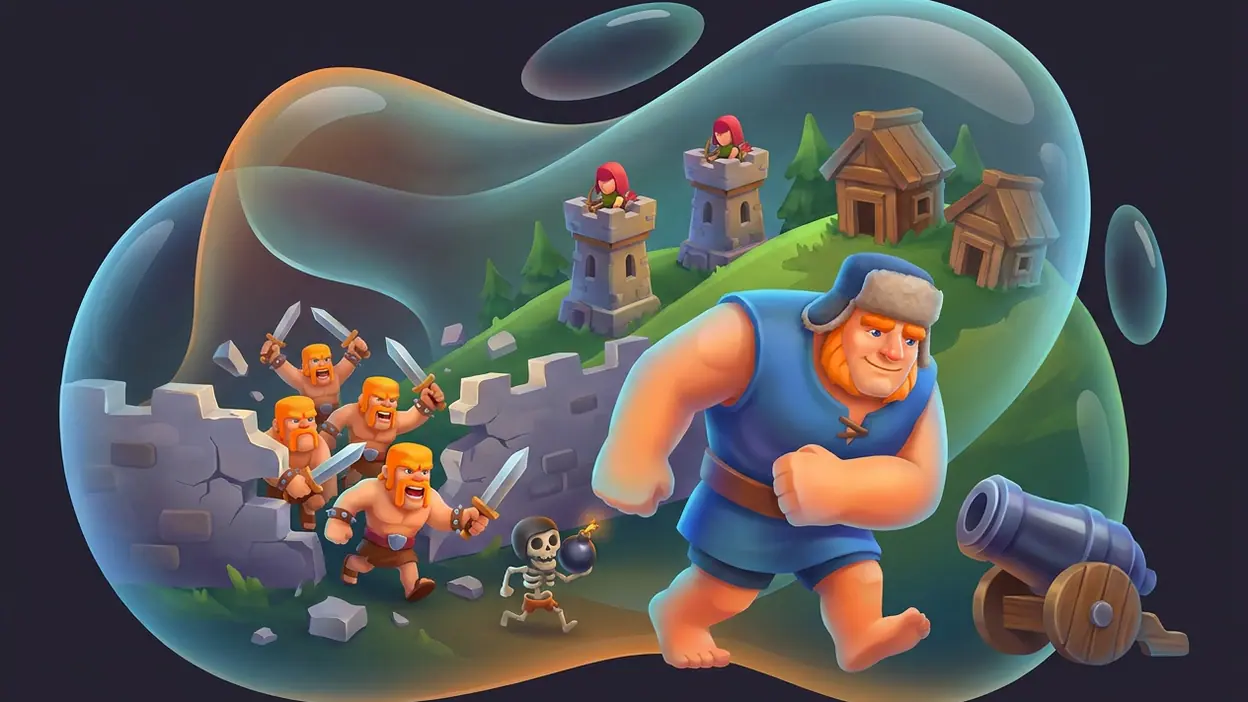
The art gives this world its charm. The colors are bright, the buildings have chunky silhouettes, and the troops are readable at a glance even when an attack turns into a crowded brawl. Barbarians charge with swords raised, Archers fire from behind the frontline, and Giants lumber into defensive fire like they have somewhere important to be. It is cartoon warfare with enough visual clarity to support actual tactical decisions.
The humor is understated but constant. Buildings wobble, troops make their intentions obvious, and the village feels busy rather than grim. That tone keeps defeat from becoming too punishing. A raided base is a setback, not a tragedy, and the next round of repairs gives you something concrete to do. The look has stayed recognizable because it serves the mechanics: bright, legible, and just silly enough to keep the grind from feeling severe.
Who it is perfect for, and where it can grate
This is a strong fit for players who like to plan in short bursts and return to a project over days or weeks. If you enjoy arranging defenses, learning troop roles, and gradually improving a base you can call your own, the game has remarkable staying power. It also suits social players who want a reason to coordinate with a Clan without committing to long, uninterrupted sessions.
It is less ideal for anyone who wants every session to deliver a complete, self-contained campaign mission. The economy can steer you toward repeated attacks, and the upgrade timers can put a hard pause on a plan you were enjoying. There is also a familiar asymmetry to online village games: a strong raid can feel exhilarating, while coming back to find your own stores depleted is less fun. The shield and recovery systems soften that sting, but they do not erase it.
Players who prefer direct control may also need time to adjust. Once deployed, troops follow their own targeting logic, so a carefully imagined route can unravel when a unit chooses a nearby building instead. That unpredictability is central to the game, but it can look like the controls are ignoring you when the real issue is that your plan did not account for troop behavior.
How it sits beside other mobile favorites
Plants vs. Zombies is the sharper comparison for compact tactical clarity: both games make unit choice and placement immediately understandable, but Clash of Clans stretches that decision-making across a persistent village and a multiplayer economy. Last War: Survival Game and Whiteout Survival lean harder on ongoing progression and management, while Clash of Clans keeps the raid itself at the center. Its building timers matter, but the attack is still the moment that gives the whole system its pulse.
That distinction is important. Clash of Clans does not ask you to treat a village as a checklist of upgrades. It asks you to understand how one choice changes another: a wall arrangement influences an attacker’s path, the path determines how long defenses can fire, and the resulting loot shapes your next improvement. This interlocking structure is why the game remains compelling even when the broad loop is familiar.
Why it is worth installing now
There is a particular pleasure in arriving late to a long-running game and finding that its central idea still works without explanation. The basics are approachable, the early raids are quick, and the village provides a clear sense of momentum. You can play in brief visits, learn at your own pace, and decide how much of the social and competitive side you want to take on. It does not require you to become a hardcore tactician before the first attack becomes fun.
More than anything, the game gives ordinary downtime a satisfying shape. A spare minute can become a check on your builders; a longer break can become a raid that tests a new army. The cycle is simple enough to understand immediately, but layered enough that a better attack still feels like an achievement. If you have missed the pleasure of gradually building a place and then putting its resources to work, this is an easy recommendation.
Final verdict
Clash of Clans earns its longevity through a strong balance of patience and spectacle. The village gives you a reason to return, the raids give you a reason to care, and the Clan layer can turn private progress into a shared win. Timers, repeated resource runs, and the occasional stubborn troop can test your patience, but they do not obscure the sharp design underneath. Install it if you want strategy that arrives in lively, bite-sized attacks and keeps a bigger plan waiting between them.