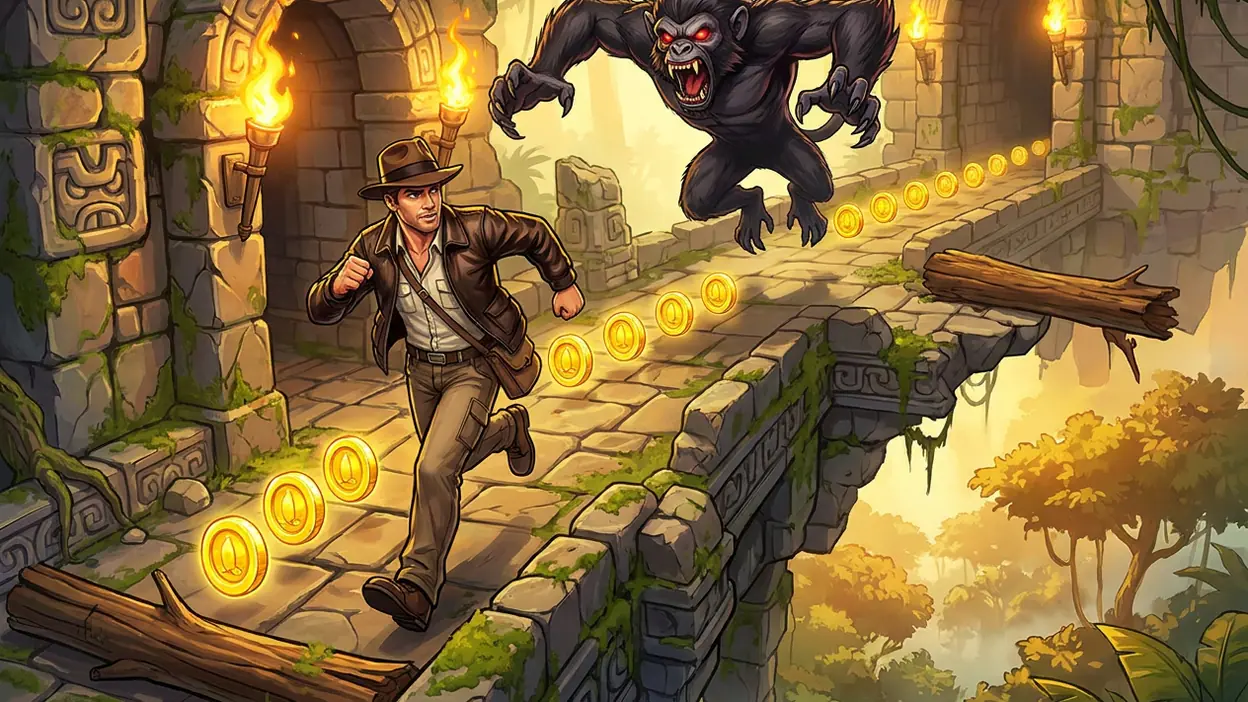
Temple Run 2 Still Nails the Chase, but Recovery Is Less Certain

Temple Run 2: Endless Escape makes failure feel wonderfully immediate: one late swipe, one clipped jump, and the pursuing demon monkey is suddenly close enough to make the next turn feel urgent. That clean cause and effect is the game’s greatest strength, but it also sets a high bar for reliability. In a runner built around short, disposable attempts, a crash or an unclear return state can cost more than a few seconds; it can erase the run you were trying to beat. My verdict is that the core loop remains resilient to ordinary mistakes, while confidence around setup, interruption, and online-dependent extras needs more qualification than the game’s breezy pace suggests.
A failure-mode field test
The reliability promise
The promise here is not a grand campaign or a deep system to master. It is a fast restart, a readable path, and a score that gives every attempt a reason to exist. You sprint through temple ruins and cliffside routes, swipe to turn, jump, or slide, and tilt to collect coins. The demon monkey presses from behind; a stumble is visible, immediate, and usually your own. That clarity is a form of reliability: the game tells you why a run ended without asking you to interpret a complicated failure screen.

Temple Run 2: Endless Escape
Imangi Studios4.1Action
See More Apps Related to Temple Run 2: Endless Escape


The rhythm matters. A run begins almost instantly, settles into a pattern of obstacle reading and coin-line decisions, then gets faster until reflexes give way to educated guesses. Power-ups and objectives add small goals to the chase, while score chasing supplies the long tail. The game is built to make a lost attempt feel cheap enough to try again. The catch is that this works best when the game itself remains predictable. Its forgiving restart loop cannot compensate for lost progress, a disrupted session, or a purchase state that is difficult to understand.
First setup failure points
Temple Run 2 has a low barrier to entry: the basic controls are learned through play rather than a lengthy tutorial, and the first run quickly shows what a swipe does. That is good design for a game meant to be picked up in spare moments. It also means the early experience leaves little room to explain account state, cloud saves, notification prompts, or what might depend on a connection. Those details can vary by device, operating-system version, and current game build, so I would not treat a smooth first launch as proof that every setup path is equally clear.
The practical setup risk is less about a complicated form and more about assumptions. A returning player may expect a previous run, currency balance, or unlock to carry across devices; a new player may tap through permissions without knowing which are optional. Before changing phones or reinstalling, check the game’s current account and save options rather than assuming that progress is backed up. If a permission prompt appears, consider whether its purpose is clear and whether declining it blocks only an optional feature or something you actually need. That distinction is not always obvious from a quick tap-through.
Mistakes and reversibility
On the track, mistakes are unusually legible. Swipe too early at a bend and the character misses the turn; jump into an obstacle and the collision ends the run. The lesson arrives in the same frame as the consequence, which makes repeated play a form of practice rather than guesswork. Coins and objectives reward attention, but chasing a tempting line can pull your eyes away from the next hazard. I like that tension: greed is a choice you can recognize, not a hidden rule waiting to punish you.
Reversibility is narrower. A failed run can be restarted, but its distance and score are not something you can undo. Depending on the version and circumstances, the game may present a continuation or revival option, sometimes connected to an ad or another resource. Treat that as a decision point, not a guaranteed safety net: availability and terms can change, and the interface should be read before spending anything. If a purchase or reward does not appear as expected, avoid tapping repeatedly in a panic. Confirm the transaction or reward status first, then use the game’s support route if needed.
Worth Reading Next

Telegram Is More Than a Messenger, and That Comes With Trade-Offs
FPS Shooting Gun Games Offline Has the Right Idea, but Old-School Gunplay
More From Our News Desk
View All


The game is forgiving about learning, not about recovering a lost run. That is a fair distinction for an endless runner, provided players understand it. The restart button restores momentum, not the attempt that just ended.
Interruption and return
Temple Run 2’s short-session design invites interruption. A message arrives, the screen locks, a call takes over, or the player simply puts the phone down. In an endless run, there is no natural chapter boundary to promise a clean return. The game may pause or resume depending on the device and the way it lost focus, but that behavior can differ across operating systems and builds. I would not promise that a run will survive every backgrounding event, nor assume that returning to the app means the previous state is intact.
For a practical test, pause deliberately before leaving whenever the game offers a pause control, and expect an active run to be at risk if the app is interrupted without warning. On return, check the screen before making another swipe: a run may have resumed, ended, or returned to a menu. That small habit prevents a second mistake from turning an uncertain state into a definite lost attempt. The game’s quick restart makes the cost modest, but a high-score run is exactly when a surprise interruption feels least harmless.
Connectivity pressure
The running itself is fundamentally a reflex loop, so a weak connection should not be confused with a bad swipe or a difficult obstacle. Core play is generally the part of the experience least dependent on a live network, while ads, store content, leaderboards, events, and account-related services may require one. The exact boundary can shift with the release and the feature being used. If a reward ad fails to load or a leaderboard stops updating, that does not necessarily mean the run data is corrupt; it may simply be the online feature that cannot complete.
In low-signal conditions, I would avoid starting a transaction or relying on an online reward until the connection stabilizes. Do not repeatedly request the same purchase because the first confirmation is delayed. Likewise, a score that has not appeared on a ranking screen should not be treated as proof that the local run vanished. Check again after reconnecting and give syncing a moment. Compared with a network-centered game, Temple Run 2 has a meaningful advantage here: the central action does not need a squad, a match lobby, or a live opponent to feel complete. Its peripheral services are the uncertain part.
Unclear states
Endless runners communicate danger well because the road is in front of you. They are less naturally equipped to explain invisible states: whether a score has saved, whether a reward is pending, whether an event timer has expired, or whether a purchase is still processing. A brief spinner or a return to the main screen can leave more than one plausible explanation. When that happens, the best move is to separate what you know from what you are guessing: note whether the run ended locally, whether the device had a connection, and whether the game showed a confirmation.
This is where familiar simplicity can mislead. A menu that feels easy to navigate is not necessarily evidence that an account or cloud save is healthy. Nor does a missing online feature necessarily mean the whole game is offline or broken. If the state concerns money, a permanent unlock, or substantial progress, stop and verify before taking another action that could duplicate a purchase or overwrite data. For an ordinary failed run, restarting is usually the sensible answer; for an unclear account state, patience is safer.
Recovery guidance
Recovery should start with the smallest, least destructive checks. If a run appears frozen, wait briefly, then try the device’s normal app-switching controls rather than repeatedly tapping the game. If the app closes, reopen it and inspect the current screen before starting a new run. For a network feature, restore a stable connection and retry once. For an apparent purchase issue, check the store’s transaction record and the game’s support information before buying again. These steps are general precautions, not a claim that every failure can be repaired.
Keep the game updated through the official store, but do not uninstall it as a first troubleshooting step if you care about local progress. Save and account behavior can vary, and removing app data may make a recoverable problem permanent. If you contact support, include the device model, operating-system version, game version, approximate time, and a concise description of what happened. A screenshot can help with a stuck menu or missing confirmation, but avoid sharing payment details or other sensitive information. Good recovery advice is deliberately boring: preserve evidence, avoid duplicate actions, and change one thing at a time.
Where evidence is missing
There is a limit to what a field review can responsibly certify. Background behavior depends on the phone’s memory management and power settings; online services can change; and different builds may handle saves, revival prompts, or events differently. Without a controlled test across multiple devices and versions, I cannot promise exact pause behavior, guaranteed cloud recovery, or uninterrupted offline access to every mode and reward. Players should check the current store listing and in-game help for the release they actually use.
That uncertainty is not a knock against the game’s core design. It is a boundary around the claim. The chase is easy to judge directly: controls teach themselves, obstacles read clearly, and a failed attempt is cheap to replace. Account recovery and transaction handling are different questions, and a satisfying run does not answer them. Reviews should not turn a familiar game into a promise of flawless data safety.
Who needs more certainty
Casual players who want a quick reflex challenge will likely find the risk profile acceptable. A lost run stings, then the next one starts. The game’s compact loop suits a commute, a waiting room, or a brief break, and the gradual rise in speed gives repeated attempts a satisfying pulse. Players who care mainly about beating their own score can enjoy it without needing every online feature to behave perfectly every time.
More cautious players should look harder before relying on it. If you are moving progress between devices, making purchases, pursuing time-limited events, or treating a high score as an important record, verify the relevant save and account mechanisms first. Parents setting up a child’s device should also review purchase and advertising options rather than assuming the game’s simple controls make every surrounding interaction simple. For comparison, a chess app can preserve the meaning of a session through a saved position, while a runner’s central prize is often one fragile streak of momentum. That difference makes interruption more consequential here than the light presentation suggests.
Resilience verdict
Temple Run 2: Endless Escape is resilient where its design says it should be: it absorbs ordinary player errors, makes the cause of a failed run easy to read, and gets you back into the action without ceremony. Its strongest recovery tool is the loop itself. You learn, restart, and try to hold the road for a few seconds longer. That is not data recovery, and it should not be mistaken for it.
My recommendation is confident but bounded. Play it for the immediate thrill of a chase that turns tiny decisions into real pressure, and expect the occasional run to end because life interrupted or your thumb did. Before trusting it with purchases, long-term progress, or a critical event score, confirm how the current version handles saves and online rewards on your device. Temple Run 2 remains an excellent game for making failure fun. It is less convincing as a guarantee that every failure outside the track will be easy to reverse.