Candy Crush Saga’s Staying Power: The Habit That Keeps Players Coming Back

Candy Crush Saga does not need a dramatic comeback story because it never really left. Its candy-colored boards still surface in commutes, lunch breaks, family chats, and the quiet gaps between tasks. The game’s current cultural momentum is less a sudden discovery than a recurring cycle: someone reaches a stubborn level, asks a friend for help, and reminds a whole group that the old habit is still sitting there, ready to resume. That is the key to its staying power. Candy Crush is not chasing novelty so much as making familiar play easy to restart.
That distinction matters in a crowded casual-game market. New releases can spike through a sharp visual gimmick or a viral clip, then fade once players have seen the trick. Candy Crush Saga has a more durable engine: a simple match-three loop, a huge supply of levels, and social progress that can travel without requiring anyone to become a devoted fan. It is both a game people actively play and a shared reference they can pick up in conversation. Its persistence is the trend.

Candy Crush Saga
King4.6Casual
See More Apps Related to Candy Crush Saga


Why the Sweet Board Keeps Returning
A familiar game in a fresh feed
There is no single reason Candy Crush seems to be everywhere again. Mobile play has become a dependable default for short breaks, while social feeds keep resurfacing old games through clips, recommendations, and people revisiting their own milestones. Candy Crush fits that cycle neatly. A screenshot of a high level or a complaint about one more failed attempt needs almost no explanation; the board is instantly recognizable, and the frustration is universal.
The game also benefits from a low social barrier. It does not ask players to learn a complicated world, build a public identity, or coordinate a session. A friend can mention a level, send a life, or compare progress, and the exchange is complete in seconds. That makes the game travel through ordinary relationships rather than relying entirely on creators or organized communities. Its spread often looks less like a campaign and more like a familiar topic resurfacing at the right moment.
Its rivals help clarify the appeal. My Talking Tom 2 and My Talking Angela 2 build attachment around caring for a character, while Bridge Race turns movement and competition into quick spectacle. Candy Crush asks for neither a continuing pet routine nor a race against other players. Its pitch is smaller: look at the board, spot a match, and see what happens. That modest promise makes it unusually easy to return to.
What players actually react to
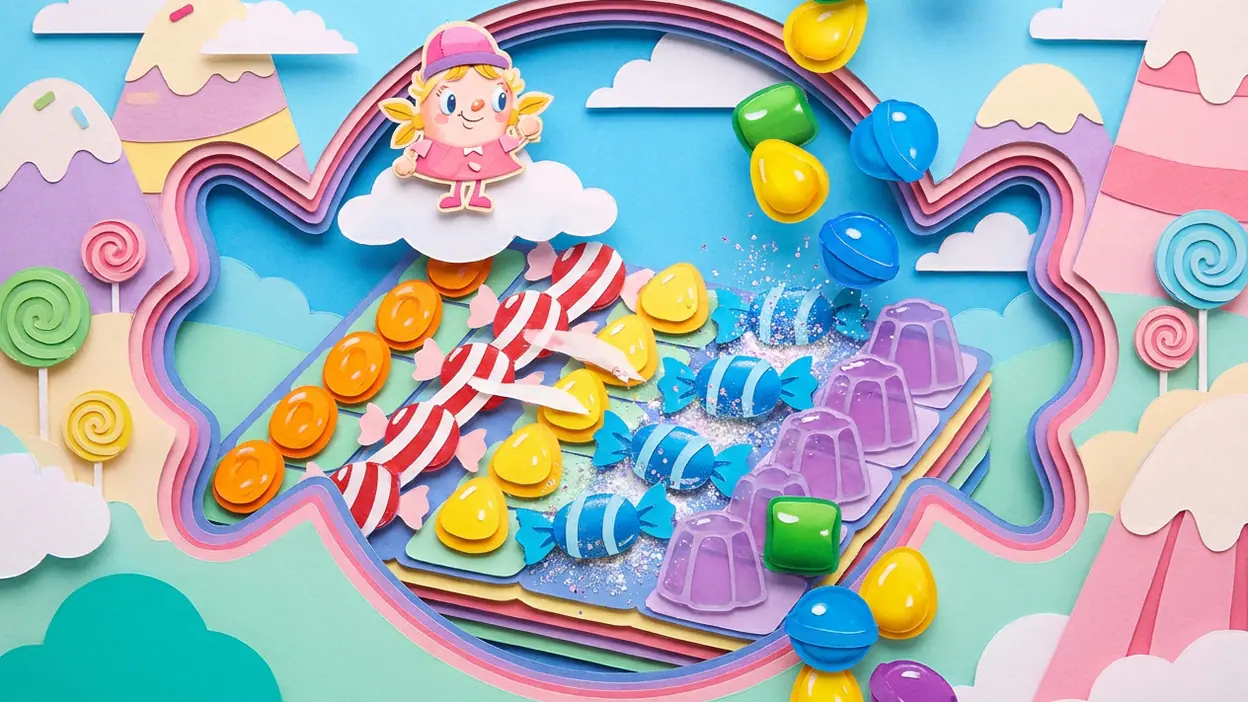
The board makes each move legible at a glance, but the best moments are not merely about clearing a row. They come from discovering a chain reaction that was not obvious when the move began. A striped candy can sweep a line; a wrapped candy can burst through nearby pieces; combinations can turn a crowded board into a sudden cascade. The screen fills with motion and color, and a careful choice produces a result that feels bigger than the tap that started it.
That visual payoff is paired with a satisfying rhythm. Levels begin with a clear objective and a limited number of moves. Players scan for a useful match, make a choice, and watch the board settle into its new shape. Sometimes the right move is obvious; sometimes a special candy changes the whole plan. The small pause before the pieces fall gives every action a little suspense. Even a short session can contain a full arc: assess, commit, hope, celebrate or reconsider.
Worth Reading Next
Google Maps Go Review: Quick to Orient, Harder to Recover

F-Secure Mobile Security Makes Everyday Phone Protection Practical
More From Our News Desk
View All
There is also pleasure in learning to read the board better. Random matching can carry a player through easy stages, but harder levels reward attention to objectives, blockers, and the way special candies can be created or combined. The game rarely demands deep strategic study, yet it offers enough room for improvement that a failed attempt can feel instructive. Players return not only because they want another win, but because they suspect they now understand the level.
The retention hook is the near-miss
Candy Crush’s strongest retention tool is the closeness of failure. A level can end with one objective unfinished, a few moves too few, or a promising setup just out of reach. That is a more persuasive invitation to retry than a distant defeat: the next attempt feels as if it might be the one that turns the board around. Lives, level gates, and limited moves give this loop its boundaries, while a long progression map keeps another goal within view.
This design is effective because the game makes progress feel concrete. A cleared level moves a marker forward; a difficult stage becomes a shared milestone; a return after time away reveals that there is still a route ahead. The reward is not just a burst of points but visible movement through an enormous sequence. That said, the same structure can become tiring. When a board depends on favorable cascades or repeated attempts, the line between a satisfying challenge and a manufactured delay can blur. Optional purchases and boosters may soften that friction, but they do not change the underlying fact that some players will hit walls.
The comparison with Candy Crush Soda Saga is useful here. Soda brings its own board conditions and visual twists, but the original remains the cleanest expression of the formula: familiar pieces, crisp objectives, and a steady rise in difficulty. The core game does not need constant reinvention because its basic puzzle still reads clearly. Its long-term challenge is keeping that progression engaging without making repetition feel like the main event.
Easy to share, harder to watch
Candy Crush is socially shareable in a quiet way. A player can post a level, ask who has beaten it, or joke about being stuck, and friends immediately understand the stakes. Sending lives and comparing progress gives the experience a light social layer without turning it into a competitive spectacle. The most compelling story is often personal: the level someone could not beat yesterday, the tiny move that finally worked, or the return to a game they thought they had outgrown.
It is less naturally suited to long-form streaming than games built around surprise, skill displays, or player-versus-player drama. Watching someone make routine matches can become repetitive unless the creator has a strong personality or the board is unusually difficult. Short clips work better: a chain reaction, an almost-impossible clear, or a spectacular cascade can communicate the pleasure instantly. The game’s visual language is its own advertisement, but its best moments are brief and self-contained.
The chatter therefore tends to sit in personal feeds, group conversations, app-store reviews, and casual recommendations rather than in a single dominant fan scene. Players can be intensely invested without treating the game as an identity. This loose, everyday kind of visibility is easy to underestimate. It may not produce the loudest online community, but it gives the game many routes back into people’s lives.
What newcomers should expect
New players will find a friendly opening: match three or more pieces, meet the level’s objective, and use special candies to make larger clears. The early stages teach by doing, so the rules arrive through play instead of a long tutorial. The colorful presentation and quick feedback make the first sessions feel welcoming, and the game works well in short bursts. There is little need to remember a sprawling story or master a complicated control scheme.
What newcomers should not expect is a puzzle campaign that stays effortless. The difficulty rises, objectives vary, and certain stages can require several attempts. The map’s scale is both an invitation and a warning: there is always more to play, but finishing the journey is not a realistic short-term goal. Candy Crush also uses timers, lives, and in-game purchase prompts as part of its free-to-play structure. A patient player can engage without spending, but should expect pauses and should treat optional offers as optional rather than as a shortcut the game requires.
For someone arriving from Bridge Race, the pace may feel less immediate because success comes from planning a board rather than racing through a course. Compared with the pet-care routines in My Talking Tom 2, Candy Crush is more disposable by design: open it, play a few levels, leave. That convenience is part of its appeal, though players who want a strong narrative or a sense of mastery through complex systems may find the formula too narrow.
How durable is the trend?
The trend looks durable because it is built on repeatable behavior, not just a burst of attention. Candy Crush can fit into a thirty-second pause or a longer attempt at a difficult stage. It does not depend on a specific device generation, a seasonal theme, or a social platform staying fashionable. The central loop remains understandable even as the surrounding mobile-game landscape changes. Familiarity itself becomes an advantage: people know what they are returning to, and that certainty lowers the cost of starting again.
But durability is not the same as endless growth. A huge level catalog can keep experienced players moving, yet it can also make the game feel like an obligation if progress becomes routine. Younger players may gravitate toward games with stronger social competition, creator-friendly moments, or more expressive worlds. Even loyal players can tire of repeated bottlenecks, constant prompts, or the sense that a level is asking for patience rather than insight.
The chatter could cool if the game’s visibility becomes associated mainly with monetization or if its challenges stop feeling fair. It could also lose some of its easy social reach as people move to new shared references. Yet these risks are gradual, not sudden. Candy Crush does not need to dominate a feed every week to remain relevant; a small return of attention can be enough to reactivate players who already know the rules and have unfinished progress waiting.
The editorial take
Candy Crush Saga remains a finely tuned casual game, and its staying power comes from a sharper design than its cheerful surface first suggests. The board is readable, the turns are quick, and special-candy cascades deliver a vivid reward for good timing and pattern recognition. Its social spread is understated but real, while its near-miss structure keeps the next attempt close enough to tempt. The weaknesses are equally clear: difficulty can feel uneven, sessions can stall behind free-to-play limits, and the core loop may wear thin for players who want constant novelty.
Still, the game’s current cultural heat is not an empty nostalgia pulse. It reflects a format that remains unusually good at turning spare minutes into a small, complete experience. Candy Crush may never be the most dramatic game to watch, but it is exceptionally good at being remembered, reopened, and played for just one more level. That is not a temporary trick. It is the reason the sweet spot has lasted.