Geometry Dash Lite Shows Both the Appeal and Limits of the Mobile Runner

One missed beat sends a square-faced cube into a spike, and the level snaps back to its opening seconds. That is the whole argument of Geometry Dash Lite: an arcade game does not need a sprawling world or a bag of modes to feel demanding, but it does need a precise rhythm, fair-feeling feedback and a reason to try again. The mobile arcade category has mastered the quick restart. Its harder task now is making repetition feel like progress rather than a test of patience.
That distinction matters because the genre’s familiar ingredients are easy to copy. A character runs forward, obstacles arrive, one touch jumps, and failure is immediate. The best games turn those simple rules into a satisfying pattern of anticipation and response. Geometry Dash Lite does this with unusually little padding. It makes the player read a course, learn its timing and perform a sequence cleanly, then asks whether another attempt sounds fun or merely necessary.

Geometry Dash Lite
RobTop Games4.4Arcade
See More Apps Related to Geometry Dash Lite


The arcade baseline has moved beyond one-touch play
Players now expect mobile arcade games to explain themselves almost instantly. Controls should be simple enough to grasp without a tutorial, sessions should begin quickly, and a mistake should not require a long walk back to the action. A strong first minute is practically part of the control scheme: it teaches the game’s language before attention wanders.
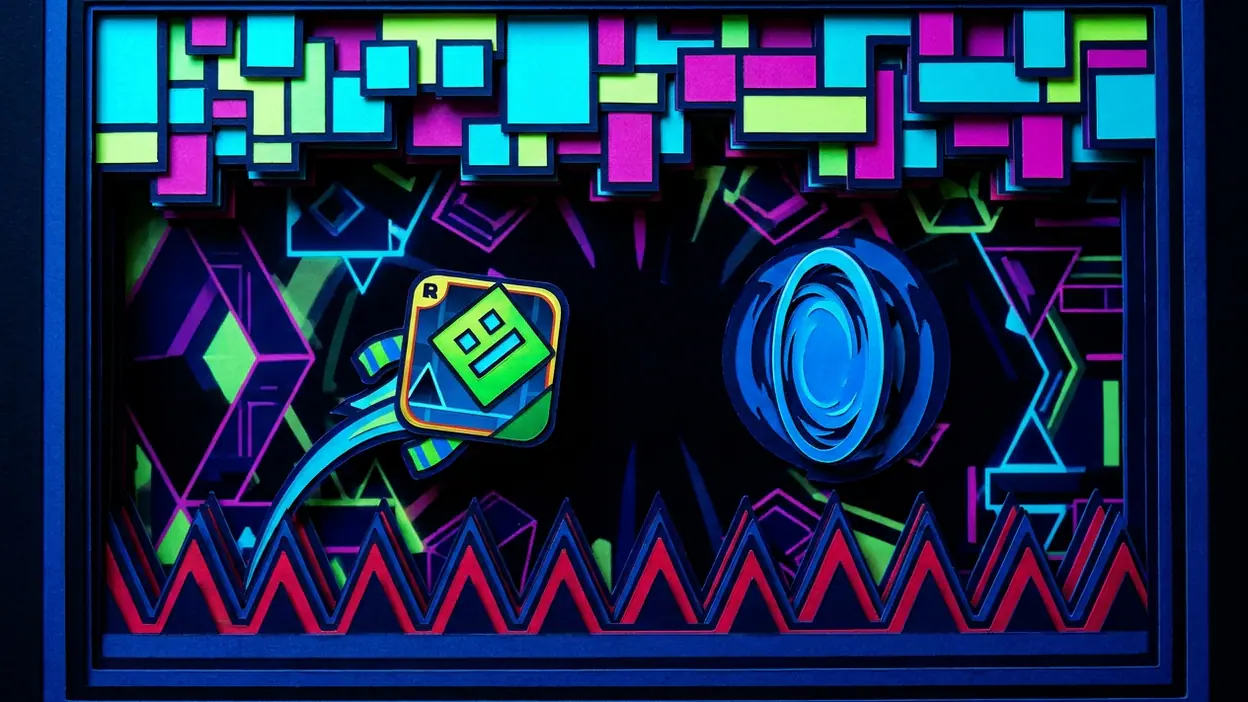
Geometry Dash Lite clears that baseline with a single input. The cube moves automatically; tapping makes it jump. That simplicity leaves no room to blame a complicated layout when a run goes wrong. The challenge lies in timing, and the interface stays out of the way. The game’s geometric courses are readable at speed, while hazards such as spikes and gaps make the cost of a mistimed tap obvious.
But the contemporary baseline is higher than convenience. Players also expect a game to respect a short session without making every session feel disposable. They want clear goals, a visible sense of mastery, and enough variation to keep a repeated action from turning into a chore. Geometry Dash Lite delivers the mastery test more convincingly than it delivers variety. That imbalance is useful: it shows both what a focused arcade game can still do and what the category increasingly asks it to do next.
Its strongest signal is the marriage of sight and sound
The game’s most persuasive design choice is not the one-button control. It is the way the course and soundtrack make that control feel expressive. The cube hops across platforms, clears spikes and passes through sequences that seem to pulse with the music. A good run does not feel like pressing at random intervals; it feels like learning a piece of choreography whose steps happen to be dangerous.
That rhythm gives failure a particular sting. You can hear and see the pattern you nearly completed, then watch the run collapse because one tap came a fraction too early. On a successful attempt, the same sequence becomes satisfying precisely because the player has internalized it. This is stronger feedback than a score alone: the reward is the clean performance itself, the moment when the course stops looking impossible and starts feeling legible.
Worth Reading Next

Gmail Makes Being Reachable Feel Like the Default

Photomath’s Quiet Community Runs on Shared Explanations

Google Messages Gets the Everyday Basics Right

Art Puzzle’s Gentle Loop Needs Clearer Recovery

Switching to Uber Means Rethinking When You Travel
More From Our News Desk
View All

There is a catch. Music can make timing intuitive, but it can also make a missed input feel like a personal failure even when the player is still learning the course. The game is demanding by design, and its crisp audiovisual language does not soften that demand. For players who enjoy repetition, the soundtrack helps turn practice into momentum. For others, the restart loop can feel like being sent back to the start line before they have had time to settle in.
Familiar conventions still do useful work
The automatic forward motion follows a well-established arcade convention. It keeps the action moving and lets the player concentrate on the next decision instead of steering, braking or managing a camera. One-touch controls also suit the phone: the action can be picked up in a spare moment, with no elaborate setup or lengthy explanation.
Instant failure and replay are equally familiar. In endless runners such as Sonic Dash Run and Temple Run, a run ends and the player returns to the start, hoping to travel farther or perform better. Hungry Shark Evolution uses a different kind of forward drive, but it also understands the appeal of a compact loop that can be entered quickly and extended through repeated play. These games make the basic mobile contract clear: let me act now, show me what went wrong, and make another attempt easy.
Geometry Dash Lite borrows that contract but changes the measure of success. Distance is not the main prize. The point is to execute a designed sequence with increasing accuracy. Where an endless runner often adds hazards to a largely continuous journey, Geometry Dash Lite asks players to memorize a finite course. That turns replay from score-chasing into practice. The shift is small in controls and substantial in feeling.
The stale convention is endless escalation without deeper play
Many arcade games keep the loop alive by adding more speed, more obstacles, more collectibles or more pressure. That works for a while, but escalation is not the same as development. A harder run can be a longer or noisier version of the same run, leaving the player with little new to understand.
Geometry Dash Lite challenges that convention by making precision, rather than accumulated activity, the center of play. The player is not asked to juggle a growing set of systems. Instead, a small vocabulary of jumps, gaps and hazards is arranged into a course that must be learned. The difficulty comes from the composition: when to jump, how soon the next obstacle arrives, and whether the player can hold the pattern in memory while acting on it.
That is a healthier design standard than simply turning up the speed, but it has its own limit. A fixed course can become familiar, and repetition alone cannot create fresh decisions forever. The game’s discipline is admirable; its narrowness is real. A clean core loop can carry a game a long way, but it cannot substitute indefinitely for new contexts, meaningful goals or a wider sense of progression.
Peers show where the category is heading
Dancing Road Color Balls Match offers a useful contrast because it connects movement to matching and color recognition. Its action still depends on timing, but the player is also reading a visual rule. That points toward a broader expectation in arcade design: a simple control can support more than reflexes if the game layers in a second kind of attention.
Stack Ball - Crash Platforms goes in another direction. Its appeal rests on a tactile sense of impact and descent, making each break through the platforms feel immediate. Compared with that physical payoff, Geometry Dash Lite is more abstract and exacting. It rewards a clean input rather than a satisfying collision. Neither approach is inherently better; together they show that players increasingly expect a mobile arcade game to give its central action a distinctive sensory identity.
The comparison also clarifies what Geometry Dash Lite does not try to be. It does not build a large world around the run, nor does it lean on the loose, improvisational pleasure of a chase. Its identity is a narrow corridor of timing and music. That focus makes it memorable, while the broader field suggests that focus now needs a strong companion: an evolving challenge, a tactile payoff, or a visible path to mastery.
The emerging standard is readable challenge with room to grow
The category’s next standard should not be complexity for its own sake. It should be simple controls paired with meaningful variation. Players should be able to understand the basic action immediately, then discover new demands through level design, pacing or a second layer of decision-making. A game can remain easy to enter while giving regular players something more interesting to master.
Geometry Dash Lite makes a strong case for the first half of that standard. Its controls are immediate, the hazards are clear, and the music gives the course a memorable pulse. Its practice loop also demonstrates that repetition need not be empty: when each attempt teaches the player a little more, failure can become information. The category should keep that lesson even as it looks beyond the simple restart-and-repeat format.
The missing piece is a more generous sense of progression. Players need not be showered with rewards, but they benefit from knowing what learning unlocks and why another session matters. A series of tightly composed challenges can provide that direction without diluting the core mechanic. By contrast, simply making the next section tougher risks confusing difficulty with depth.
Where the genre still falls short
Mobile arcade games often treat friction as a feature. A quick death and restart can sharpen a challenge, but a difficult sequence repeated without enough variation can wear down the very attention the game depends on. Geometry Dash Lite’s precision is its selling point and its largest barrier. If a player cannot settle into the rhythm, the same fast loop that feels thrilling to a practiced player may feel unforgiving to a newcomer.
There is also a broader design gap between being readable and being fair. A hazard can be visible yet still arrive with little room to react, especially when the player has not learned the course. The best arcade challenges make the reason for failure understandable and give the player confidence that practice can change the outcome. Geometry Dash Lite’s audiovisual clarity helps, but the overall experience still asks a lot of patience from anyone who wants to progress through repeated attempts.
That is not a call to make every mobile game forgiving. Difficulty can be the point. The lag is in how often the genre mistakes raw repetition for a complete relationship with the player. More thoughtful pacing, clear milestones and variety in the kind of attention demanded would preserve the bite while giving more people a reason to stay.
What players should expect next
For users, the consequence is a more useful way to judge arcade games than asking whether they are easy or hard. Ask whether the controls feel fair, whether failure teaches anything, and whether the next attempt changes the player’s understanding. Geometry Dash Lite answers those questions unevenly but compellingly. Its input is clean, its rhythm makes progress audible, and its tight focus can turn a short session into a genuine test of skill. Its narrow loop may also exhaust players who want broader goals or gentler onboarding.
That makes it a revealing example of the category rather than a complete template. The mobile arcade game of the future should keep its instant readability and satisfying restarts, while taking greater care with progression and variation. It should not bury a good mechanic under menus or systems; it should give that mechanic somewhere meaningful to go.
Geometry Dash Lite shows why the one-touch arcade game still works: a clear rule, a pulsing course and the stubborn pleasure of finally getting a difficult sequence right. It also makes the next demand plain. Speed and simplicity can win the first attempt, but only fair learning and fresh reasons to return will earn the next hundred.