FaceLab Turns the Aging Filter Gag Into a Reason to Return

Aging filters are easy to dismiss as a one-minute gag. FaceLab: Future Face Aging App has built a larger proposition out of that gag: give people a quick, personal glimpse of an imagined future, then make the result polished enough to send around. Its strength is not photographic precision. It is the speed with which a familiar face becomes a small story. That distinction explains both the app’s reach and the reason its hold on users has a ceiling.
FaceLab belongs to the photography category, but it behaves less like a camera utility than a playful portrait studio. You bring the subject, usually yourself or someone close to you; the app supplies the transformation. The exchange takes seconds, and the payoff is immediate. That low effort, paired with a result that feels personal, is the engine behind its popularity.

FaceLab: Future Face Aging App
Lyrebird Studio3.8Photography
See More Apps Related to FaceLab: Future Face Aging App


How FaceLab turns curiosity into a habit
A big idea with almost no setup
The premise needs no tutorial: choose a photo, apply an effect, and see a changed version of the face. The subject is already emotionally loaded. People recognize their own features, but they also know that a filtered prediction of aging is a stylized guess, not a forecast. FaceLab gets useful mileage from that gap between recognition and disbelief. Users can react to the image without needing to believe it.
That makes the first session unusually frictionless. A user does not need to learn a camera workflow, build an album, or decide how to edit a landscape. The app offers a clear prompt with an obvious reward. Even a result that looks exaggerated can succeed as a joke or conversation starter. For an app built around portraits, immediate legibility matters more than a long list of controls.
Why the result travels
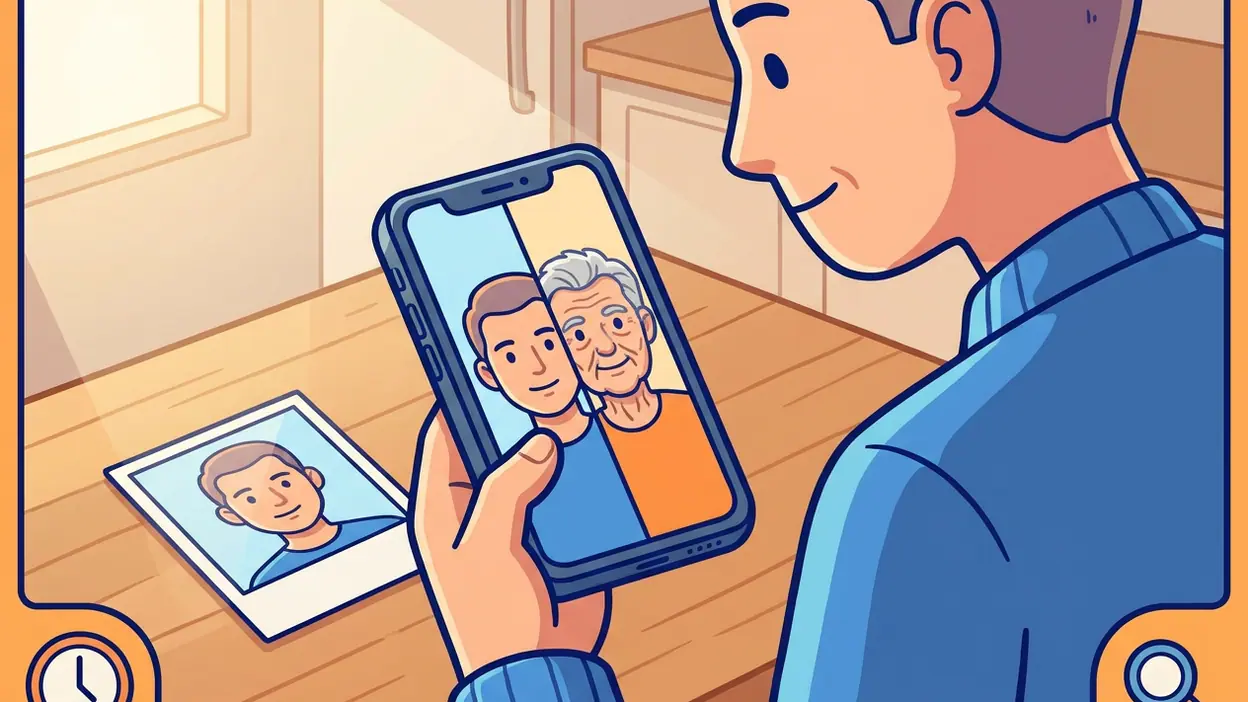
FaceLab’s output is made for the social handoff. A transformed portrait is easy to show to a friend, compare with a family member, or post alongside the original. The image carries its own premise: here is the face, and here is one possible older version. That before-and-after contrast does much of the explanatory work, so the app does not need to persuade viewers with a complicated feature pitch.
This is where FaceLab differs from Gallery, which organizes photos people already have, and PhotoScan by Google Photos, which solves the practical problem of digitizing prints. Those tools preserve or manage images; FaceLab changes their meaning for a moment. Canon Camera Connect serves a more deliberate photography workflow, linking a camera and phone. FaceLab asks for less commitment than any of them, because the point is not to make a better photograph. It is to see what happens when an ordinary one is reimagined.
Where the design gets sticky
The app’s stickiness comes from personal variation. Try a different selfie, a different expression, or another person, and the result may feel fresh enough to justify one more round. The face itself is a reusable source of material. It also invites comparison: does this version look believable, funny, or more like a relative than the person in the photo?
Worth Reading Next

Facebook Is Useful Again for the Small Logistics of Daily Life

Ludo King Keeps Its Simple Appeal as Phone Updates Change the Routine
Google Photos, Used Well: Find, Protect, and Manage Your Photos

Free Fire’s Ninth Anniversary Makes Familiar Matches Matter Again

Ceiling Fan Balancer Makes a Common Fix More Methodical
More From Our News Desk
View All


That is a light habit loop, not a deep one. Curiosity prompts the first edit; the reveal creates a reaction; sharing or comparing extends the moment; then another photo offers a new draw. The cycle works because each attempt is cheap. It can also run out quickly. Unlike a serious photo editor, FaceLab does not necessarily give users a reason to return every day to complete a project or maintain a collection. Its repeat use depends on fresh curiosity, social occasions, and the pleasure of trying the effect on another face.
The app benefits from keeping the task narrow. A broad editor must make room for crop tools, color controls, layouts, and layers. Photo Editor - Collage Maker, for example, can help assemble pictures into a finished composition. FaceLab’s central appeal is more immediate: press into a transformation and judge the face that comes back. The short path from selfie to reveal is its strongest retention feature.
What people forgive
Users are likely to forgive a certain amount of artificiality because the premise announces itself as entertainment. A generated older face need not pass as documentary evidence; it needs to look sufficiently coherent to prompt a laugh, a double take, or a conversation. That standard is kinder than the one applied to an app promising careful retouching or dependable photo management.
People may also tolerate a narrow feature set. FaceLab is not meant to replace a camera roll, a scanner, or a full editing suite. If a quick effect gives someone the moment they wanted, a lack of deeper controls is easy to overlook. The trade-off becomes harder to forgive when the app interrupts that moment with friction, obscures what is free, or makes a result feel less controllable than expected. The exact experience can vary by version and platform, so those details are worth checking before committing to any paid option.
Where the cracks show
The central limitation is also the source of the app’s magic: an aging image is an interpretation. Lighting, pose, angle, and image quality can shape how convincing a transformation feels, while the output may smooth over the individual details that make a face distinctive. It can look persuasive at a glance and still feel like a filter rather than a plausible view of the future. Anyone treating it as a genuine prediction is asking more of the tool than it can provide.
There is a broader creative limit, too. A transformation can be amusing without giving users much control over the result. People who want to adjust the mood, refine small details, or build a complete visual piece may find a general editor more satisfying. FaceLab’s focused workflow is an advantage for speed, but a constraint for anyone who wants to shape an image rather than accept the app’s interpretation.
Privacy deserves ordinary care as well. A face photo is personal, and users should understand the app’s current permissions and privacy terms before submitting images, especially pictures of other people. That is not a claim about how FaceLab handles every image; it is a sensible check for any service that processes portraits.
Who gets the most from it
FaceLab is best suited to people who enjoy low-stakes visual experiments and sharing the results. It works particularly well when there is a willing audience nearby: friends comparing versions, relatives reacting to a family photo, or a group trying the same effect on different portraits. The app’s reward is social as much as visual, and the audience helps turn a single edit into an occasion.
It is a weaker fit for photographers seeking faithful editing, users looking for an archive or scanner, and anyone expecting a scientifically grounded forecast. For those needs, Gallery, PhotoScan by Google Photos, or a more flexible editor has a clearer job to do. FaceLab does not need to beat those products at their own tasks. Its advantage is that it can make a familiar portrait feel briefly surprising.
Why rivals have not copied the whole appeal
Competitors can add filters, but a filter alone does not create a habit. FaceLab’s appeal depends on the combination of an instantly understood transformation, a recognizable subject, and an output that invites a reaction. A general-purpose editor has to serve many different goals, which can make its interface less direct for this one. A camera companion has a different audience and a different idea of success: reliable transfer and control matter more there than a quick joke.
That focus gives FaceLab a defendable position, but not an unassailable one. The effect is easy to understand and the category is easy to imitate. If the transformations stop surprising users, or if another app makes the same experience easier to share and more satisfying to control, habit can shift quickly. FaceLab’s lead rests less on a permanent technical moat than on execution: how quickly it produces an enjoyable result and how little it asks of the user along the way.
Does the dominance last?
FaceLab’s strongest advantage is likely to last as a recognizable kind of entertainment, not as an unchallenged destination. People will keep being curious about changed versions of their own faces; that instinct is broader than any single app. But interest in one particular effect can fade once the surprise has been spent. To earn repeat opens over time, FaceLab needs to keep the transformation experience fresh without burying the simple path that made it appealing.
FaceLab: Future Face Aging App gets the fundamentals right for a popular novelty app: a personal premise, a fast reveal, and an image people can discuss. Its habit loop is real but lightweight, and its imperfections are easiest to forgive when users treat the result as play rather than prediction. I would recommend it to anyone who wants a quick, shareable portrait experiment; I would not mistake it for a serious photography tool. FaceLab wins attention by making the future look like a selfie, and it keeps that attention only for as long as the next reveal feels worth seeing.