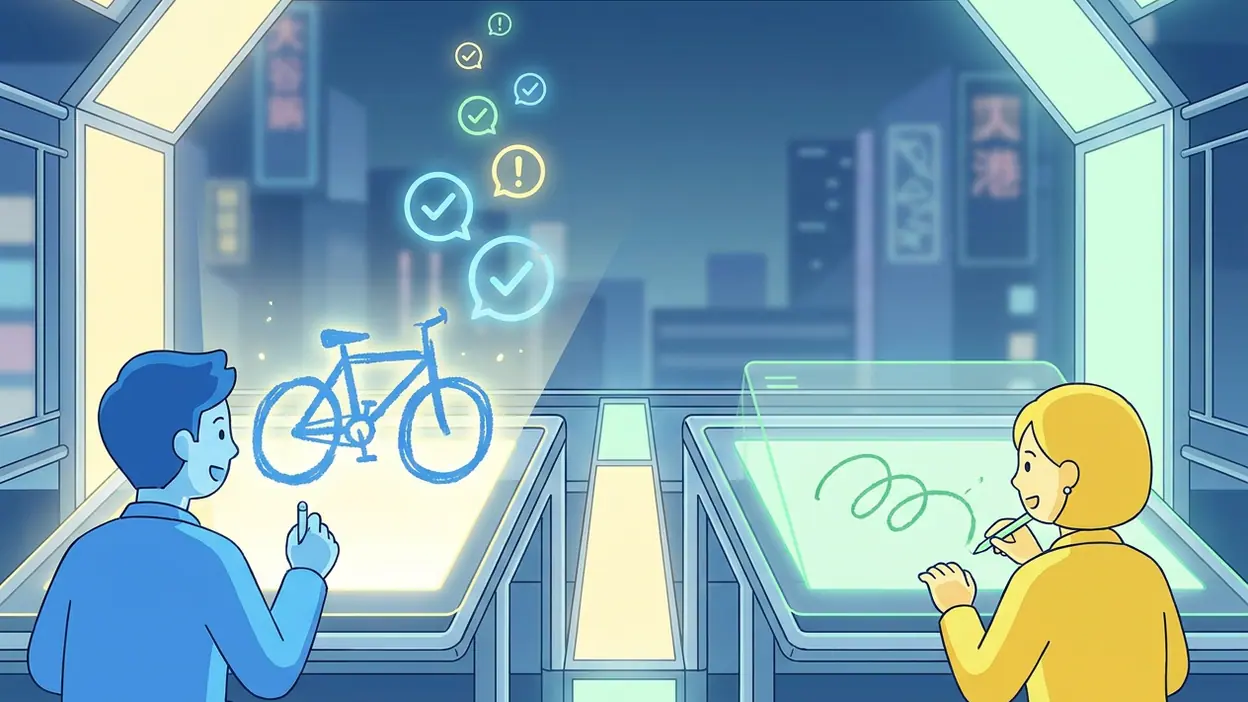
Draw it Turns Rushed Doodles Into a Moreish Guessing Duel

The funniest moment in Draw it is often the half-second before your drawing makes sense. You know the word, your finger is moving, and your opponent is already trying to guess from a few rough lines. Then the answer clicks, the round swings, and a doodle that looked hopeless suddenly feels like a stroke of genius. Draw it turns imperfect drawing into a competitive advantage, making it an easy arcade game to pick up and a surprisingly sticky one to put down.
Its appeal is not artistic skill. The game asks you to read a prompt, sketch quickly, and help other players recognize what you mean, all while keeping an eye on the race unfolding beside you. That gives each round a clear pulse: think, draw, guess, react. The rules are simple enough to understand almost immediately, but the pressure makes even familiar prompts feel lively.

See More Apps Related to Draw it


Why Draw it deserves your attention
Many quick mobile games rely on reflexes alone. Draw it adds a small burst of communication to the mix. You are not just tapping at the right moment; you are translating an idea into a picture under a time limit, then watching another person attempt the same translation. The resulting sketches are crude by necessity, and that roughness is part of the entertainment.
The game understands that a drawing can be useful without being accurate. A circle with two lines might be enough to suggest a bicycle. A hurried outline can become obvious only after a guess appears. This gap between what you intended and what your opponent sees supplies much of the comedy, while the race to finish gives it a competitive edge. It is a compact premise with a strong social payoff.
The opening hook: draw first, doubt yourself later
Rounds get moving quickly. A word appears, you choose your lines, and the opposing player is working through their own prompt at the same time. There is little room to plan a polished picture. You have to decide which details carry the meaning and leave everything else out. That first decision is where the hook lives: can you make the idea legible before the clock and the other player get ahead?
Because the prompt is hidden from your opponent, every mark becomes a clue. Too little detail and the sketch could mean several things; too much and you spend precious time decorating an idea that only needed a recognizable shape. I found myself simplifying instinctively, then adding a defining feature when the first guess missed. Those small course corrections make the game feel more involved than its bare-bones controls suggest.
How the core loop feels
The loop is easy to describe and hard to perform perfectly. You draw your prompt as clearly as possible, watch guesses arrive, and try to finish ahead. In the other lane, you interpret someone else’s hurried picture and make a guess before it disappears or the round moves on. That switch between creator and viewer keeps the action from becoming a one-note drawing exercise.
Worth Reading Next
Asphalt 8 Turns Speed into a Daily Mobile Ritual
Amazon Kindle: Reading App - Where Books and Notes Go
More From Our News Desk
View All
On a phone, drawing with a finger can feel blunt, but the game makes that limitation work for it. You are not expected to produce elegant linework. A few confident strokes are often better than a careful outline, and the time pressure discourages fussing over details. When a player guesses correctly from a sketch that barely resembles the answer, the round feels like a shared joke rather than a test of drawing ability.
The rhythm is especially satisfying when both sides are close. You glance between your own progress and the competing sketch, hurry to finish a key feature, and hope the clue lands. A quick win gives you a clean little burst of triumph; a close loss usually prompts the same thought: I could have drawn that faster. The next round arrives before that thought has time to fade.
Progression, rewards, and the pull of another round
Progression gives the short matches a larger frame. Wins and in-game rewards provide reasons to keep playing beyond the immediate satisfaction of solving a prompt, while unlockable or collectible elements give regular sessions a sense of accumulation. The details of that economy can vary with the game’s version and events, but the design is plainly built around repeated rounds and small goals rather than a long campaign.
That structure suits the format. A drawing duel does not need a sprawling story to justify its next match; it needs a fresh prompt and a reason to care about the result. Rewards add a modest nudge, but the strongest payoff remains the moment a guess lands or a clever sketch carries you past the opponent. The game is at its best when progression supports that loop instead of trying to replace it.
Its replay value comes from human variation. Even if a prompt feels familiar, the other player’s drawing changes the problem. One sketch may be instantly readable, another may look like an entirely different object until a single line reveals the answer. That unpredictability keeps the rounds from feeling like a fixed sequence of quiz questions.
Why sessions are hard to stop
Draw it uses short rounds to make stopping feel premature. There is always time for one more, and a narrow loss gives you an obvious reason to try again. A win can be just as persuasive: you want to see whether you can keep the streak going, or whether the next opponent will make you work harder. The game’s quick reset keeps those impulses close together.
It also creates stories small enough to carry into the next match. You remember the terrible sketch that somehow worked, the prompt you overcomplicated, or the moment your opponent guessed correctly before you had finished the outline. That is a better retention trick than simply filling the screen with tasks. The rounds generate their own anecdotes, and those are easy to share or replay in your head.
A bright, readable identity
The visual presentation keeps attention on the drawings and the competition. The interface is colorful and uncomplicated, while the sketches themselves become the stars: rough, immediate marks that communicate just enough to keep the round moving. Rather than aiming for a realistic art tool, Draw it treats the canvas as a playing field. Its identity comes from the contrast between a clean, cheerful presentation and pictures made in a hurry.
That contrast matters because the game could easily make beginners feel exposed. Instead, the fast pace and deliberately simple drawing tools lower the stakes. A bad picture is not a failure of taste; it is part of the joke and sometimes an effective clue. The style helps the game feel playful even when the race becomes tense.
Who it is perfect for, and where it frustrates
This is a strong fit for anyone who likes quick competitive games, word puzzles, or low-pressure multiplayer with room for a laugh. It works especially well in short breaks, when a long match would be a commitment but a few drawing duels are easy to squeeze in. You do not need drawing confidence, and players who enjoy guessing as much as sketching will get the most out of the back-and-forth.
It is less satisfying if you want deep strategy, precise controls, or a substantial solo adventure. Finger drawing has obvious limits, and the timer can make a prompt feel less like a creative challenge and more like a scramble. There can also be a gap between what you draw and what the game accepts or your opponent understands; when a sensible sketch fails to communicate, the round can feel arbitrary. Repetition may set in for players who want major changes in mechanics rather than new prompts and competitive outcomes.
The game’s online character also means its best moments depend on the quality of the match. A responsive opponent turns a simple round into a proper duel; an uneven or unengaged one can flatten the exchange. That is not a flaw unique to this game, but it matters because the human interpretation is central to the fun.
How it compares with arcade favorites
Stickman Hook is about momentum and timing, while Attack Hole - Black Hole Games builds its appeal around swallowing more and more of the environment. Crazy Kick! Fun Football game turns a simple sports idea into a burst of movement, and Spinner Merge Blitz leans on quick progression and satisfying combinations. Draw it shares their pick-up-and-play clarity, but its distinguishing feature is expression: the player’s own sketch becomes the action.
That makes it a different kind of arcade recommendation. It is not as purely kinetic as Stickman Hook, nor does it offer the same sense of growth through accumulating objects as Attack Hole - Black Hole Games. Instead, it finds excitement in communication under pressure. If you want movement first, those rivals may suit you better. If you want each round to hinge on a picture, a guess, and a little bit of nerve, this is the one to try.
Why install it now, and the final verdict
Draw it is worth installing when you want a game that starts quickly and does not demand a long attention span. Its central idea is immediately understandable, but the combination of drawing, guessing, and racing gives the simple format enough texture to earn repeat visits. It is also a good choice for players who are tired of arcade games where every round feels identical: here, the other person’s interpretation can change the whole mood.
My recommendation comes with a clear caveat. This is a lightweight, match-driven game, not a deep creative tool or a campaign you will spend hours exploring in one sitting. Its controls can be imprecise, and its strongest rounds depend on a lively opponent. But when the exchange clicks, the game makes those limitations feel like ingredients: messy drawings, fast guesses, and sudden reversals all feed the same cheerful momentum.
Draw it earns its place on a phone by turning a familiar party-game idea into a brisk arcade duel. The rewards help, the bright presentation keeps it approachable, and the rounds are short enough to invite another try. Install it for the sketches that somehow make sense, the guesses that arrive just in time, and the small thrill of beating someone with a drawing you would never frame.