Woodturning Review: A Calming Game of Careful Cuts

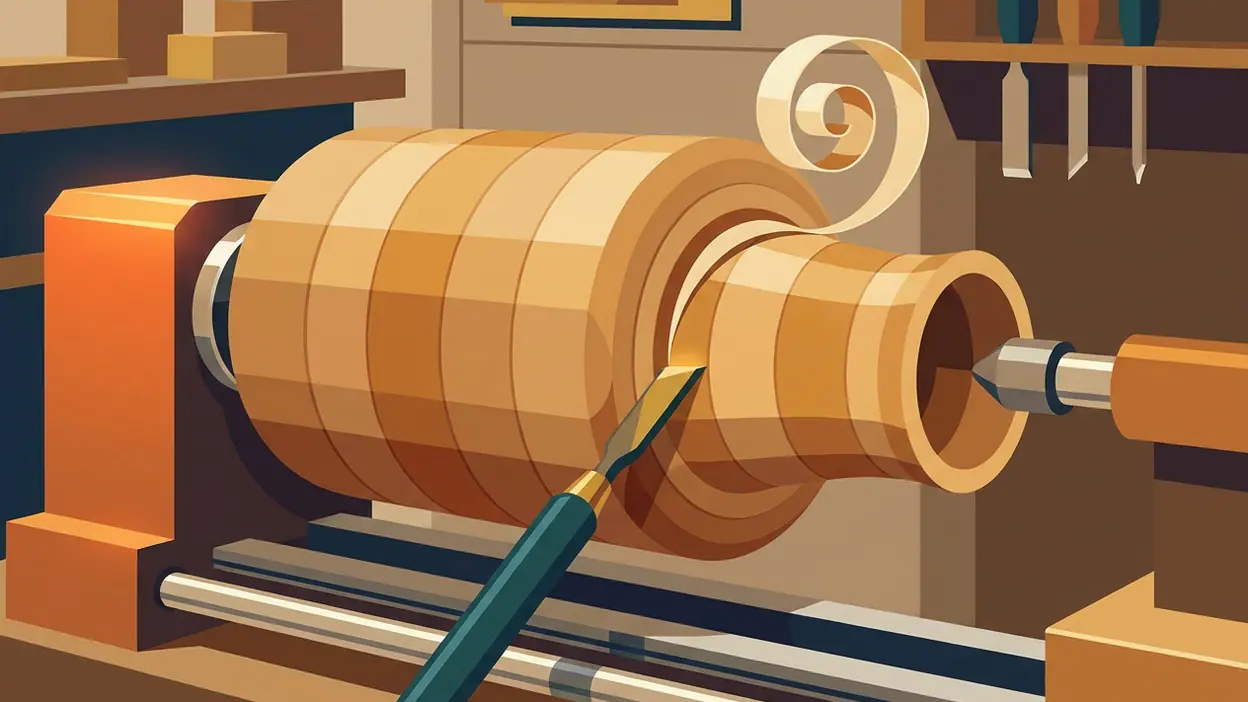
A rough block of wood spins between two supports, and a blade waits just above it. One careful pass turns the square edges into a clean curve; one impatient swipe can carve away too much. That small tension is the whole appeal of Woodturning: it makes shaping an object feel immediate, physical, and just risky enough to keep your hands moving. This is a simple simulation with a remarkably clear hook, and its best sessions end with the satisfying sense that your own judgment made the result.
The game does not ask you to master a sprawling workshop or learn a long list of rules. It asks you to look at a shape, choose how much material to remove, and make something customers will accept. That modest idea gives Woodturning room to be both a calming time-killer and a little test of restraint. It deserves attention not because it simulates every part of woodworking, but because it understands exactly which part feels good.

Woodturning
VOODOO3.8Simulation
See More Apps Related to Woodturning


From spinning timber to finished craft
The first cut is the hook
The opening appeal is visual before it is mechanical. A blunt, uneven piece of wood begins to rotate, and the cutting tool meets it with a soft stream of shavings. A few strokes reveal a vase-like waist, a rounded handle, or a more unusual silhouette. The transformation is quick enough to feel rewarding, but slow enough that you can watch the shape emerge rather than simply tap through a result screen.
There is a pleasing contrast between the steady rotation and your less predictable hand. Keep the tool against the wood and the surface becomes smooth; push too far and the profile narrows in a way that may be hard to correct. The game communicates that risk with a clean, close-up view instead of a wall of instructions. I understood the central pleasure within moments: make a confident cut, pause to inspect the outline, then decide whether it needs one more pass.
A tactile loop built on restraint
Each job follows a compact rhythm. You start with a target shape or customer request, turn the timber by moving the blade across it, and try to match the intended profile without cutting beyond the useful material. After shaping, you refine the surface, apply color or finish, and move on to the evaluation. The exact tools and steps can vary as the game opens up, but the essential loop stays readable: observe, carve, smooth, decorate, deliver.
That sequence works because each stage changes the way you look at the object. During carving, I watched the outline. During smoothing, I cared more about the finish and remaining rough spots. Decoration then offered a chance to make the piece feel less like a checklist and more like a small personal choice. The game is at its best when those phases flow together, letting a quick job feel like a complete miniature project.
The controls are deliberately approachable, and that suits the premise. You do not need to memorize complicated inputs to make progress. Still, the blade is not a precision woodworking instrument in your hands; it is a broad gesture translated into a cut. The result can feel more forgiving than real craft, but that simplicity keeps the loop brisk and makes the game easy to pick up in spare minutes.
Worth Reading Next

Zoom Workplace Wants to Own Your Whole Workday, Not Just Your Meetings

My Talking Tom’s Daily Ritual: Can a Viral Pet Loop Last?

Piano Music Go Turns Quick Breaks Into a Test of Rhythm and Precision

How to Use Yelp to Find Better Places With Less Scrolling

Temu Turns Bargain Hunting Into a Daily Habit
More From Our News Desk
View All


Progress measured in better-looking work
Finishing orders provides the basic sense of advancement. Customers set the next task, successful work brings rewards, and new opportunities give you reasons to keep shaping. The most immediate reward is not a dramatic level-up. It is the visible before-and-after: a plain piece of timber becomes a finished object, and the job is complete because you took it through every stage.
That modest progression fits the game better than a complicated skill tree would. There is a steady pull from completing another order, but the craft itself remains the main attraction. You get small goals, a new shape to interpret, and the chance to improve your handling. For players who enjoy collecting upgrades or unlocking a deep catalogue of systems, this may feel thin. For anyone who likes short creative tasks with a clear finish line, the light structure is part of the comfort.
There is also an understated personal reward in learning to stop. Early on, it is tempting to keep shaving because the surface looks better with every pass. But more cutting is not always better; a balanced profile often matters more than a perfectly uniform silhouette. Once I started leaving a little room for judgment rather than chasing every possible refinement, the results felt more intentional.
Why one more order is tempting
Woodturning is easy to play in short bursts, yet the finished-object cycle makes stopping feel oddly premature. A job often takes only a little attention, so there is always time for one more. The next piece may have a different contour, the last finish may have left a detail you want to improve, or you may simply want to see how a more daring cut turns out.
The game does not need a dramatic story cliffhanger to retain attention. Its momentum comes from completion and variation. You watch a rough shape become recognisable, finish the surface, receive the outcome, and immediately have another small creative problem waiting. That cadence is closer to a satisfying craft routine than a high-pressure arcade challenge. It is absorbing without demanding that you block out an hour.
Its strongest sessions are the ones where you settle into the motion: carve a little, check the profile, adjust, then smooth and finish. The loop can be soothing, but it is not entirely passive. You are making repeated decisions about what to remove and when to leave the wood alone. That combination of calm repetition and tiny judgment calls is the reason short visits so often stretch into several orders.
A clean workshop fantasy, not a woodworking course
The presentation keeps attention on the workpiece. The spinning wood and visible shavings make each cut legible, while the close framing gives the transformation room to land. It is a bright, simplified version of a workshop, designed for quick recognition on a small screen rather than for documentary realism. The style helps the game stay approachable: the process looks tactile without becoming fussy.
That identity matters. This is not a broad building sandbox, where the pleasure comes from assembling a whole structure, and it is not a general collection of handcraft activities. Its appeal is narrower and more focused: shaping one object with a tool, then giving it a finished look. The game makes that narrow focus feel like a deliberate choice rather than a missing feature.
Who will love it, and who may drift away
Woodturning is a strong fit for players who enjoy casual simulations, visual transformations, and tasks that feel complete in a few minutes. It suits a quick break particularly well: there is no elaborate setup, and the reward arrives right in front of you. If you find satisfaction in sanding a rough edge, arranging a tidy design, or watching a simple process reach its polished endpoint, the appeal is easy to understand.
It may also work for players who like creative play but do not want a blank canvas. The customer request gives each job a purpose, while the shaping and finishing leave enough room for personal choices. That balance makes it less intimidating than an open-ended art tool and more hands-on than a passive collection game.
The trade-off is repetition. Once the core stages are familiar, the same basic sequence returns often, and the control model does not develop into a deeply technical craft simulation. Some cuts can feel imprecise, especially when you are trying to make a very specific contour; the game simplifies the relationship between your gesture and the final shape. If you want complex workshop management, realistic tool physics, or a long campaign with a changing cast of mechanics, the light structure may wear thin.
That simplicity also explains why it should not be judged by the standards of broader creative games. Craftsman: Building Craft is about constructing and exploring; Acrylic Nails! and Tie Dye focus on different forms of visual customization; 2 3 4 Player Mini Games thrives on quick competition. Woodturning is quieter than those alternatives and more committed to a single tactile action. The comparison sharpens its identity: it is not trying to be a toolbox of activities, but a compact game about the pleasure of making one object well.
Why install it now
There is a particular charm in games that make progress visible without burying it under systems. Here, every order gives you a fresh piece of material and a direct reason to work on it. You can play casually, take a break, and return without needing to remember a complicated plot or strategy. The appeal is immediate, and the central mechanic remains easy to explain: turn the wood, shape the piece, finish the surface.
That clarity makes it a good choice when you want a game that feels active but not demanding. It will not satisfy every player for the long haul, and its repetition is a real limitation rather than a hidden secret. But the core sensation is strong enough to justify a download: a rough block becomes a polished object through a series of small, readable decisions.
The verdict
Woodturning's real reward is the moment you stop cutting and realise the shape is right. The game wraps that moment in a fast, tidy cycle of orders, smoothing, and finishing, then nudges you toward another piece before the satisfaction has quite faded. Its modest depth and occasional lack of precision keep it from becoming a serious craft simulator, but those limits do not erase its focused charm.
If you want a sprawling simulation, look elsewhere. If you want a tactile mobile game that makes a few spare minutes feel pleasantly productive, Woodturning is an easy recommendation. It turns a simple action into a convincing little ritual, and that is more than enough to make one last order feel like a good idea.