My Talking Tom’s Daily Ritual: Can a Viral Pet Loop Last?

A virtual cat does not need a new trick to become a daily ritual; it needs to make the old ones feel personal again. My Talking Tom has the kind of simple, instantly legible premise that travels well through short clips and word of mouth: care for a cartoon kitten, watch him react, and return later to see what needs doing. The renewed buzz around it is less a sudden reinvention than a reminder of how effectively a small routine can spread. Its staying power, though, depends on whether affection survives repetition.
That distinction matters. The game is easy to show someone in seconds, but its real appeal is built over many brief visits. It turns basic chores into a loop of attention, reward and personality. For players who grew up with virtual pets, the familiarity has its own pull; for newcomers, the bright reactions make the idea understandable without a tutorial-heavy pitch. The trend has a credible engine, but not every viral revival becomes a lasting return.

My Talking Tom
Outfit7 Limited4.3Casual
See More Apps Related to My Talking Tom


Why a simple cat keeps showing up
The timing of a resurgence is rarely explained by one feature. A mobile game can re-enter the social feed because old players share a memory, younger players discover a character through a clip, or a familiar format gets picked up by creators looking for something playful and low-stakes. Tom suits all three routes. His expressions are broad, the premise needs almost no explanation, and a tiny moment of care can be turned into a complete piece of content.
There is also a useful contrast with Candy Crush Saga. That game makes its appeal visible through a board clearing in a burst of color; Tom makes it visible through a face changing in response to the player. One is spectacle built from a puzzle outcome, the other is a small performance that appears to belong to a character. That difference gives clips a more personal feel. The player is not only showing progress; they are showing how their cat behaved.
Still, “everywhere” can be an illusion. A few widely shared videos can create the impression of a universal comeback when the audience is concentrated in particular communities or age groups. Buzz is evidence of renewed attention, not proof that the game has regained a permanent place on everyone’s home screen. The stronger signal is whether people who arrive through a clip keep opening the game after the novelty wears off.
The reaction is the reward
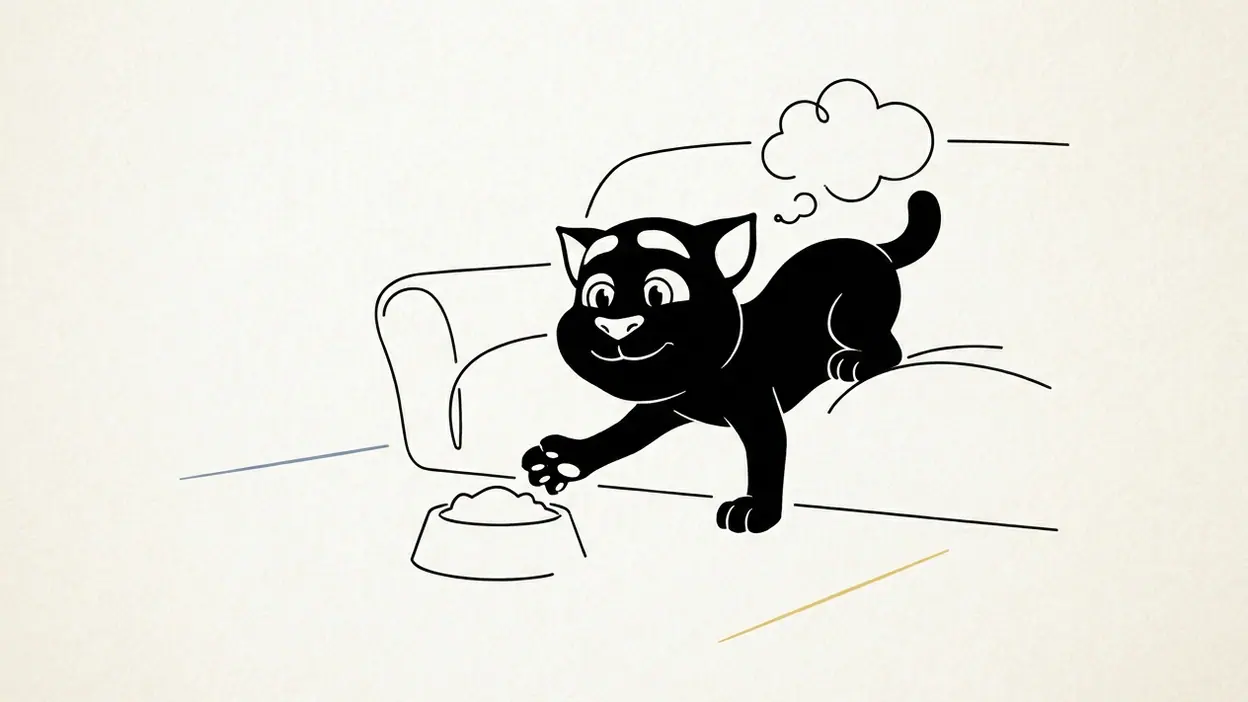
At the center of the experience is a plain but potent exchange: the player acts, and Tom responds. Feed him, clean him up, put him to bed or start a game, and the kitten’s changing expression supplies the emotional punctuation. The interaction is modest, but it gives routine tasks a face. A meter filling up is abstract; a sleepy or delighted pet makes the result feel immediate.
That is why the game’s best moments are often not dramatic. They happen in the pause after an action, when Tom looks pleased, hungry or worn out. The player is encouraged to read a little personality into these animations. It is a familiar form of make-believe, yet it works because the feedback arrives quickly and clearly. There is no long ramp before the game becomes understandable, and no complicated system to master before a new player can feel useful.
Worth Reading Next

Google Play Games Is for Playing, Not Streaming

Zoom Workplace Wants to Own Your Whole Workday, Not Just Your Meetings

Piano Music Go Turns Quick Breaks Into a Test of Rhythm and Precision

How to Use Yelp to Find Better Places With Less Scrolling

Temu Turns Bargain Hunting Into a Daily Habit
More From Our News Desk
View All

This emotional shorthand also sets limits. Tom’s responses are designed reactions, not an open-ended conversation, and repeated actions can make that obvious. Players who want deep customization, strategic decisions or a story that keeps unfolding may find the character’s range narrow. My Talking Tom 2: Pet Game extends the familiar idea, while My Talking Angela shifts the focus to another character; those alternatives underline the appeal of the format, but also how much depends on the individual player’s attachment to the pet.
A habit built from small returns
The retention hook is not a single cliffhanger. It is the quiet sense that Tom will need something later. Care tasks create a rhythm of checking in, tending to a need and leaving again. Mini-games provide a more active stretch when the player wants one, while rewards and collectible progress give those visits a point beyond maintenance. The session can be short without feeling incomplete: do a few things, see a reaction, and put the game away.
That lightness is a strength in a crowded mobile routine. Unlike a game that asks for a long, focused sitting, Tom can fit between other tasks. But the same design can become a chore if the player feels summoned by meters rather than drawn by affection. A virtual pet works best when a check-in feels like a choice. If every return becomes an obligation, the cute premise starts to resemble a list of errands.
Pou is a useful comparison here. It also makes care and upkeep the core of a virtual-pet relationship, showing that the basic loop has durable appeal. Tom’s advantage is the clarity of his animation and the polished, expressive presentation; its challenge is that players already know the shape of the routine. Keeping them interested requires enough variety in play and rewards to make care feel like more than repeating yesterday’s sequence.
Easy to share, harder to sustain
Tom is naturally streamable because the game offers visible reactions without demanding expert play. A creator can show a funny expression, a small surprise or a sequence of pet-care actions and let the character carry the moment. Viewers do not need to know a competitive ranking system or a complicated backstory to understand what is happening. The game is legible at a glance, which is a valuable quality in fast-moving social feeds.
Its social spread is also intimate rather than competitive. A clip can invite a response such as “I used to play this” or “look at what my Tom did,” instead of asking viewers to judge a high score. That opens the door to nostalgia and personal stories. It is a softer kind of sharing than the level-clearing triumphs of Candy Crush Saga, and it can make a familiar game feel newly relevant without changing its basic identity.
But the same low barrier means a clip may be more memorable than the session that follows. Social media rewards the funniest few seconds; the game has to earn the next ten minutes on its own. The chatter tends to gather around Tom’s expressions, childhood memories, virtual-pet comparisons and the satisfaction of caring for a small digital character. That conversation is warm and accessible, though it does not automatically produce the kind of ongoing community built around competition, elaborate fan theories or constant new content.
What newcomers should expect
New players should expect a gentle routine, not a deep simulation. The game introduces its premise through direct actions and friendly feedback, then lets players settle into a cycle of care, play and small progression. Tom is the draw, and the experience works best when the player enjoys checking on him for its own sake. There is plenty to understand quickly, but the central loop remains visible rather than hiding a complex system underneath.
That simplicity is a welcome entry point for younger players and anyone looking for a casual game that does not punish a short session. It also means there is little need to treat the game as a skill test. The pleasure comes from responsiveness and ownership, not from perfect timing or mastering a difficult level. For someone expecting the depth of a long-form adventure, however, the pace may feel thin. The game is designed around small returns, not a dramatic campaign.
It is also worth approaching any free-to-play mobile game with ordinary caution around interruptions, optional purchases and prompts. The exact experience can vary with the current version and device, so newcomers should take a moment to check settings and decide what kind of spending or notifications they are comfortable with. A pet-care game should remain a pleasant break, not a source of pressure.
How durable is the comeback?
The trend has a better chance of lasting as a steady niche than as an unstoppable wave. Virtual pets tap into a durable human instinct: we like to nurture something that notices us. The format does not depend on a season of licensed content or a temporary meme, and its basic appeal can reach players who have never followed mobile-game trends closely. That gives Tom a sturdier foundation than a joke that burns out as soon as the feed moves on.
Durability will depend on freshness. Familiar care actions can comfort, but they can also flatten into repetition. Players need enough variety in mini-games, rewards and expressive moments to make each return feel chosen. The game must keep its simple identity without letting the routine feel frozen. My Talking Tom has the advantage of a recognizable character and an immediately readable loop; it cannot rely on nostalgia alone to hold a newcomer who has no childhood memories attached to it.
The strongest sign of a lasting trend would be a shift from “I remember this” to “I still play this.” The first response creates a burst of attention; the second proves a habit has formed. A virtual pet can earn that habit, but only if the visits remain rewarding after the initial novelty and social exposure fade. The game’s emotional feedback gives it a real shot, even if it does not guarantee that every player will stay.
What could cool the attention
Repetition is the obvious risk, but it is not the only one. Players can tire of being nudged to check in, particularly if care begins to feel like a demand. A narrow range of interactions can make Tom’s reactions seem less spontaneous over time, while a flood of similar social clips can drain the surprise from the format. There is also the simple fact that an audience drawn in by nostalgia may not want to rebuild a daily routine around a game they once left behind.
There is a competitive risk, too. My Talking Angela and My Talking Tom 2: Pet Game offer nearby ways to stay within the same character-led world, while Pou shows how familiar the virtual-pet formula has become. These comparisons help explain the genre’s resilience, but they also give players alternatives if one version stops feeling fresh. Tom’s strongest defense is not feature count; it is the immediate warmth of his character and the ease with which the game turns a tap into a reaction.
My verdict is that the habit is the trend. My Talking Tom has a credible route back into conversation because it is simple to share, easy to understand and unusually good at making basic care feel personal. Its appeal is real, but its ceiling is set by the same simplicity that makes it welcoming. Expect a charming, low-pressure companion with a sturdy return loop, not a reinvention of mobile gaming. If Tom keeps giving players small reasons to care, the buzz can settle into a durable niche; if the check-ins become chores, the feed will move on faster than the cat does.