Clash Royale’s Latest Revival Faces Its Next Balance Test

Some mobile hits spread because a clip makes them look spectacular. Clash Royale spreads because a clip makes you think you could have played that moment better. A tower falls by a sliver, a spell lands half a second late, and the whole match becomes an argument anyone can follow. That mix of instant legibility and lingering regret explains the game’s renewed visibility better than any claim that it has suddenly become new. Its current buzz is a return to an unusually durable formula, amplified by a community that never stopped dissecting it.
The important distinction is that this is not a fresh discovery so much as a recurring revival. Supercell’s real-time card battler has been around long enough to accumulate veterans, rivalries, old strategies, and a steady stream of people who leave and come back. Updates, balance changes, competitive moments, and creator coverage can make the arena feel newly active, but they are fuel for an established social loop. The game’s strongest trend is not a brief spike; it is its ability to keep finding new reasons to be discussed.

Clash Royale
Supercell4.4Strategy
See More Apps Related to Clash Royale


Why the arena is suddenly everywhere again
Clash Royale has the ideal shape for rediscovery. A match is brief enough to fit into a spare moment, yet packed with decisions that remain debatable after the result is settled. A returning player can recognize the King Tower and the familiar lanes immediately, then find that card balance, deck conventions, and the current competitive mood have moved on. That combination produces a useful kind of friction: the game feels familiar, but mastery is not waiting exactly where you left it.
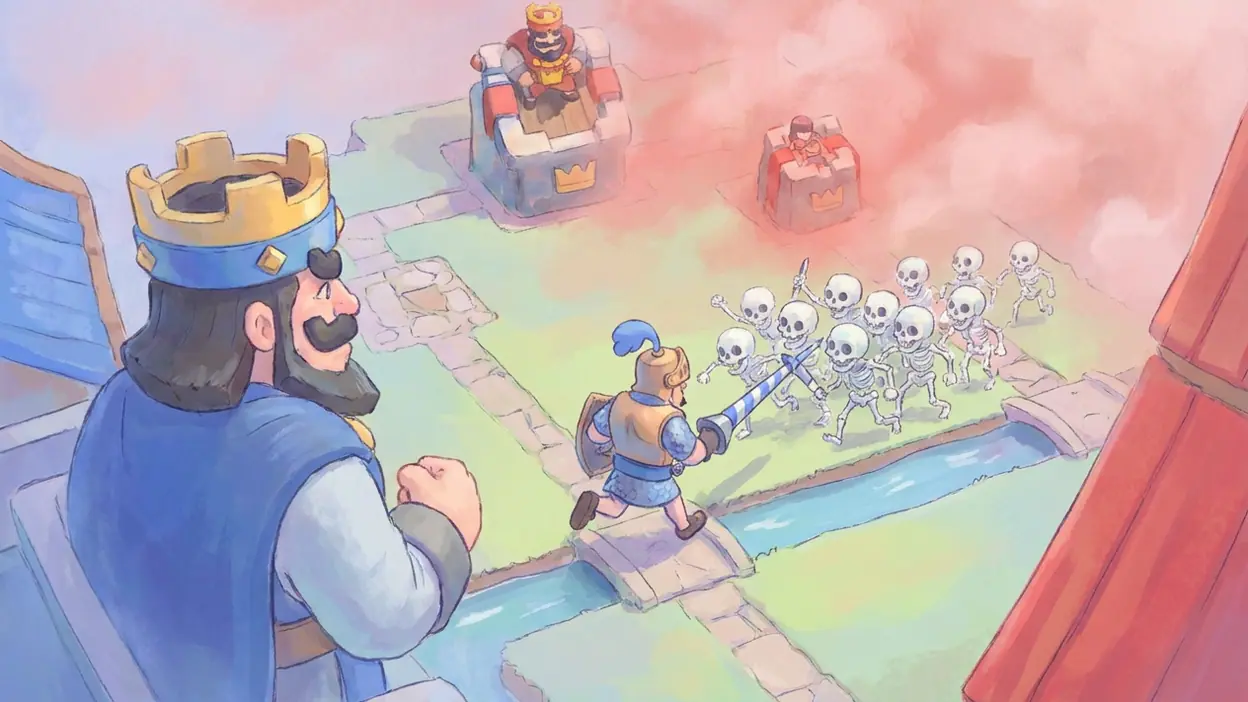
Its social spread also benefits from a clean visual grammar. Two towers, two bridges, a river, and troops moving toward an obvious objective: even a viewer who has never played can see danger approaching. That makes a last-second defense or a sudden counterpush easy to share without a long explanation. The game has more strategic depth than its bright, toy-like presentation first suggests, but it does not hide the immediate stakes behind menus or lore.
There is a broader mobile contrast here. Clash of Clans makes progress feel like tending a persistent base; Plants vs. Zombies turns planning into a readable sequence of defenses. Clash Royale puts the decision and its consequence in the same small arena, often within seconds. That tight feedback loop gives it a sharper clip-friendly pulse than games built around long campaigns or extended sessions.
What players react to
Players react to the reversal. One moment, an opponent’s push seems unstoppable; the next, a cheap distraction pulls a heavy unit away from the tower while a spell clears the support troops. The pleasure is not simply watching a powerful card hit hard. It is seeing a plan meet another plan, with both players forced to adjust in real time. A well-timed defense can feel as satisfying as a tower takedown because it announces that you understood the opponent’s intention first.
The best matches create a readable rhythm: build elixir, probe, defend, then spend the opening before it closes. That rhythm never becomes entirely comfortable. Commit too much to one lane and a counterpush can punish you; wait too long and the opponent takes control of the pace. The arena is compact, but the pressure has room to swell. A tiny mistake can turn a calm exchange into a desperate scramble, and the replay in your head often lasts longer than the match itself.
Worth Reading Next

Gmail Makes Being Reachable Feel Like the Default

Photomath’s Quiet Community Runs on Shared Explanations

Google Messages Gets the Everyday Basics Right

Art Puzzle’s Gentle Loop Needs Clearer Recovery

Switching to Uber Means Rethinking When You Travel
More From Our News Desk
View All

That emotional compression matters. Many mobile games promise a satisfying session; this one can deliver a complete story in a few minutes. You get an opening read, a mid-match adjustment, and a closing test of nerve. When the contest is close, the King Tower’s final sliver of health becomes a plot point. When it is not, the player still has a clear explanation for what went wrong, whether or not that explanation is fair.
The retention hook is mastery, with a catch
The reason to return is not just collecting cards. It is learning how to make a deck work under pressure: what to hold, what to reveal, which threat deserves an answer, and when to stop defending and start forcing a response. Progress makes that learning tangible, but it can also muddy the experience. Card levels and account progression mean that a close tactical contest is not always an equal contest, particularly for someone climbing with an underdeveloped collection.
Deck-building gives the loop its long tail. A familiar set of cards can play differently depending on its support, its spell coverage, and the threats it is built to answer. Change one slot and the deck may gain a reliable defense but lose the ability to punish a slow opponent. The result is an endless series of small hypotheses: try this, notice where it fails, and revise. That is compelling for players who enjoy refinement, but punishing for anyone expecting a single favorite lineup to stay effective forever.
There is also the mobile-game cadence of rewards, events, progression, and reasons to check back. These systems can keep a routine alive, but they are less interesting than the matches themselves. If the daily prompts start to feel like chores, the core duel has to be good enough to pull the player back on its own. Often it is. Not always: a stale deck environment or a run of uneven pairings can make the climb feel like maintenance rather than discovery.
Why it travels through streams and group chats
For creators, the game supplies compact drama with a clear payoff. A viewer can understand a risky push, watch it fail, and immediately debate the alternative. Live matches invite commentary because each card played gives the audience something concrete to judge. The best videos do not need elaborate framing: a strange deck, an unexpected defense, or a near-impossible comeback already contains a beginning and an ending.
That makes the social life of the game unusually practical. Friends can compare decks, challenge one another, share a replay, or send a clip with the implicit question, “Would you have defended this?” The conversation is built into the mechanics. Unlike a clip from Last War: Survival Game, where the appeal may depend on a broader progression pitch, a Royale replay can be understood through the choices visible on screen. Its spectacle is not just a big effect; it is a decision under a clock.
Still, streamability can exaggerate the experience. Spectacular comebacks travel farther than routine losses, and expert play can make a difficult system appear effortless. A newcomer watching a top player may see quick placement and clean counters without noticing the years of matchup knowledge behind them. The clips are an excellent invitation, but a poor promise that every ladder session will feel like a tournament highlight.
Where the chatter sits, and what newcomers should expect
The conversation tends to gather around practical disputes: which cards deserve a place in a deck, how a balance change shifts matchups, what a popular player is using, and whether a loss came from a misplay or an unfavorable pairing. That is healthy evidence of an active game. People are not only admiring its art or remembering its launch; they are arguing about how it works now. But the same argument can turn into a demand for constant change, even though a competitive game also needs enough stability for skill to matter.
Newcomers should expect a friendly first impression followed by a steeper learning curve than the cute characters suggest. The basics are easy to grasp: defend your side, manage elixir, and attack the enemy towers. Knowing why one defense works and another leaks damage takes longer. Early matches teach the language of the arena, while the broader collection and ranked climb reveal the pressures of progression. It helps to treat the first stretch as practice, not as proof that every loss has exposed a permanent skill gap.
It also helps to choose a deck and learn its purpose instead of swapping cards after every defeat. Understanding one plan gives each mistake a useful shape. Was the problem poor timing, an uncovered air threat, or spending elixir without a clear payoff? That kind of self-review is part of the pleasure for a strategy-minded player. Someone seeking a relaxed, low-stakes collection game may find the competitive framing more intense than expected.
Does the trend have staying power?
Its durability comes from a rare pairing: low time commitment and a high ceiling for judgment. The match ends quickly, but the game keeps offering fresh interactions among cards, opponents, and changing balance. That is a stronger foundation than a marketing wave or a single viral gimmick. The core question, “Can I answer what is coming and punish the response?” remains legible even as the details shift.
There are credible ways for the heat to cool. Repeated balance changes can make players feel that their practiced decks have been invalidated rather than refreshed. A narrow competitive environment can turn discovery into imitation, with everyone chasing the same reliable answers. Progression friction can discourage new players who lose to stronger collections before they have learned the tactical language. And if the community’s most visible moments become arguments about fairness rather than clever play, attention may remain loud while affection thins out.
Durability does not require every player to stay forever. It requires the game to keep producing reasons to return: a new matchup to learn, a friend to challenge, a deck to repair after a bad run. Royale has shown that it can do that across multiple cycles of attention. Its social presence is not proof that every moment is balanced or welcoming, but it does show how naturally its small matches generate stories and opinions.
My editorial take is that this is less a sudden comeback than a familiar game catching another strong current. The arena still works because it turns strategy into visible, personal stakes: you can see the mistake, the counter, and the chance to do better next time. Its weak points are real, especially progression pressure and the fatigue of a shifting competitive landscape. But as long as matches remain quick, readable, and rich in decisions, Clash Royale has more than a viral clip to sustain its audience. It has a durable argument players are happy to have again.