Slither.io Turns Snake Survival Into a Shared Spectacle

In slither.io, the most memorable opponent is often the one you never meet. A rival’s sudden turn, a crowded knot of glowing bodies, or the bright trail left after a giant snake disappears can change the whole match in seconds. The game’s community is not built around chat rooms or elaborate team systems; it forms inside the arena, through visible risk, imitation, rivalry, and the stories players carry away. That makes its ecosystem both unusually immediate and unusually fragile: the crowd creates the drama, but the game gives it few tools to become a lasting community.
A public arena with no introductions
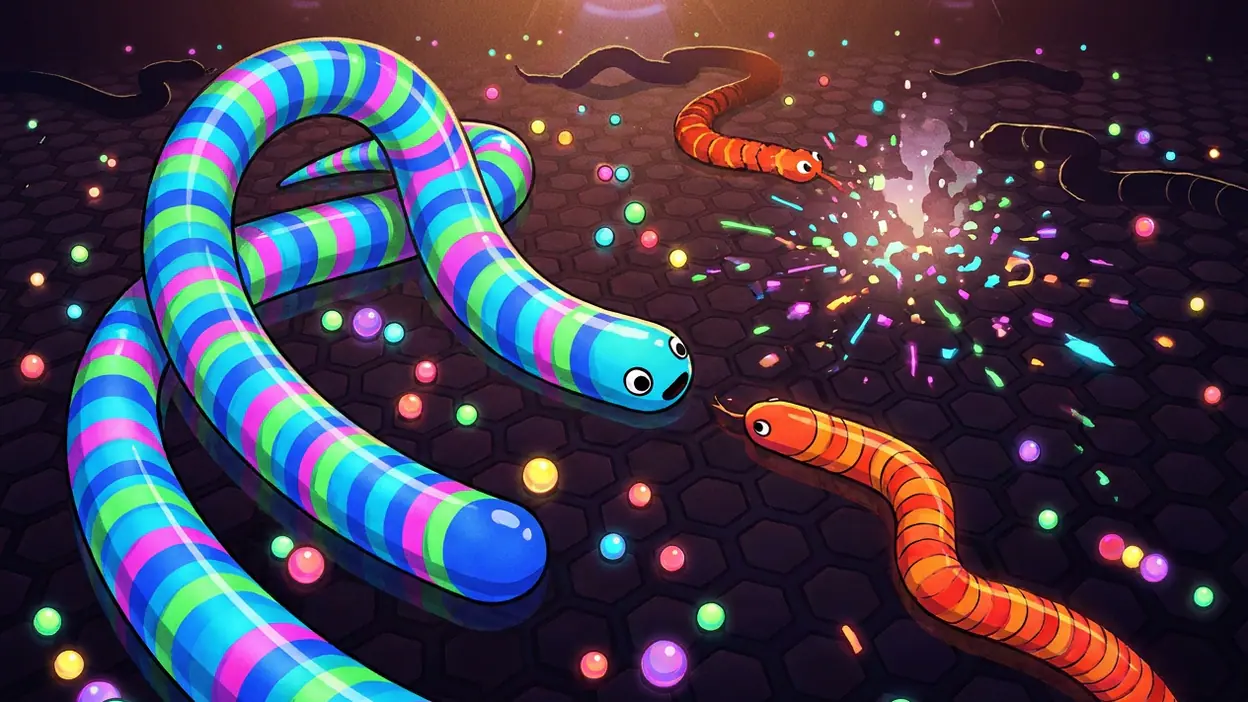
The basic ritual is easy to understand. You guide a small snake across a dark field, collect glowing pellets to grow, and try to make another snake collide with your body. When one falls, its remains become a tempting haul for everyone nearby. There is no need to memorize a campaign or learn a complicated role. Each match begins with the same blunt question: can you grow without becoming careless?

slither.io
Lowtech Studios3.9Action
See More Apps Related to slither.io


That simplicity makes every other player part of the rules. A long snake can fence off space, threaten a smaller one, or circle a patch of pellets; a compact newcomer can slip through gaps that larger bodies cannot. The shared arena turns ordinary movement into a social signal. A feint reads as a challenge, a close pass as a warning, and a sudden boost as either panic or a calculated gamble. Even without conversation, players constantly interpret one another.
The result is a community hook that arrives before any formal community feature does. You are not simply collecting points against a timer. You are entering a room full of strangers whose choices reshape your route. The game’s strongest social feature is that presence itself: other players make the field feel unpredictable, and their mistakes become opportunities that everyone can see.
How players participate
Participation is mostly behavioral. Players compete for space and pellets, test how close they can pass, and decide whether to chase a vulnerable rival or protect their own length. There are no required teams, shared objectives, or extended conversations in the central loop. Cooperation can happen informally, such as two snakes avoiding each other for a moment, but the design does not make an alliance durable or binding. The safer assumption is that every temporary peace can end as soon as a better opportunity appears.
This makes the game legible to newcomers. The controls ask for direction and a boost, while the strategic lesson is learned by watching the arena: avoid being boxed in, do not treat size as safety, and remember that a rival can turn a small mistake into a meal for the whole crowd. Losing is quick, and the next attempt is close at hand. That short reset lowers the emotional cost of joining, which is essential for a game whose social life depends on a steady flow of fresh bodies.
New players enter without needing an invitation or a long tutorial. They can begin cautiously at the edge of the action, then move toward dense traffic as confidence grows. The learning curve is less about mastering a catalogue of moves than about reading distance and timing. A sudden boost may save you from a collision, but it also spends length; a tight turn may trap an opponent, or trap you first. Those lessons are easy to observe and hard to perfect, a combination that gives repeat matches their pull.
Worth Reading Next

B612 AI Photo&Video Editor: The Secret to Its Addictive Appeal

Word Search - A Cultural Lens on Digital Habits

Shooting Ball: Mastering Precision and Strategy in Mobile Gaming

How Google Messages Strengthens Its Grip in the Tech Ecosystem

Alibaba.com: Mastering the B2B Marketplace Ecosystem
More From Our News Desk
View All


Rituals, spectacle, and player-made meaning
The recurring ritual is the run itself: start small, gather a little mass, search for a safer path, then decide whether to risk the center. Players often tell themselves they are only going to try once more after an early collision, because a new match offers a clean chance to apply the lesson they just learned. The rhythm is brisk enough to encourage that promise. There is little downtime between defeat and renewed participation, so a narrow escape or a careless death can feed directly into another attempt.
Long snakes create a second kind of ritual. Their size makes them moving landmarks, drawing attention from players who want to follow, challenge, or avoid them. A large body can shape traffic without a spoken command: a coil narrows a route, while a broad sweep can scatter smaller rivals. Yet size also invites risk. The more space a snake occupies, the more visible and vulnerable it becomes. That reversal gives the arena its best spectator-like moments, as a dominant player’s confidence can turn into a sudden scramble for the glowing remains.
Players contribute to the culture by supplying their own goals. One may chase a personal length record; another may practice close circling or try to survive in a congested patch. These are plausible ways to play, not proof of a coordinated community challenge system. The game itself does not need to announce a shared event for players to create one in their heads. Its open-ended match structure leaves room for self-imposed tests, and the visible consequences make those tests easy for nearby rivals to witness.
That contribution has limits. Unlike games organized around persistent guilds, complex builds, or shared creative tools, slither.io gives players little in the core match to preserve together. A remarkable run can be remembered or described elsewhere, but the arena does not necessarily turn it into a durable record of a group’s history. The player is a performer and an audience member at once, yet most of that performance disappears when the match ends.
Social friction and safety questions
Competition is the point, but it can still produce friction. Players may feel targeted when a larger snake pursues them, or cheated when a collision seems to happen a fraction sooner than expected. In a fast-moving match, visual proximity and abrupt turns can make cause and effect feel harsher than they are. The game also rewards opportunism: a player who waits near a dangerous encounter may collect its aftermath without taking the same risk. That can feel crafty to one person and irritating to another.
There is a useful distinction between a competitive action and harassment. A rival cutting off your route is ordinary play in a shared survival arena. Repeated personal targeting, abusive messages, or unwanted contact would be a different matter, but the details depend on the version and its available social features. Those features can change over time and across platforms, so it would be careless to claim that every player encounters the same communication or reporting tools.
Moderation is therefore a meaningful unknown, not an excuse to invent assurances. The basic match can create rivalry without requiring players to speak, which limits some common routes to abuse. At the same time, any connected game may involve account, naming, or communication systems beyond the immediate movement loop, and their safeguards should be checked in the current version rather than assumed. Parents and players who care about reporting, blocking, or privacy controls should review the game’s present settings and store information before treating the arena as a fully supervised space.
The absence of sustained conversation can make the encounter feel cleaner, but it also means the game offers little way to explain intent or repair a misunderstanding. A near-collision is simply over, and a player who feels singled out has few in-match tools to turn that feeling into a conversation. This keeps matches brisk while making the social environment more anonymous. The trade-off is not automatically bad; it is part of why the game is easy to enter, and part of why its community may feel impersonal.
Where the network value lives
The network value appears in the density of the arena. A field with many active rivals produces more near misses, more sudden openings, and more dramatic collapses than a quiet one. Other players are not an accessory layered on top of the game; they are the source of its most consequential surprises. The same movement system would still let someone steer and collect, but it would lose much of its tension if the arena were empty.
That dependence creates a delicate ecosystem. A steady stream of participants helps every match feel alive, while the low barrier to entry makes it easy for someone to add one more body to the crowd. But quick access does not guarantee long-term attachment. Because the game’s social connections may be temporary and its central ritual repeats without much structural change, players can leave just as easily as they arrive. The network is strongest moment to moment, not necessarily over months or years.
Sharing can extend the experience beyond a single run when players recount a close escape, a dramatic collapse, or an unusually long survival. Those stories are natural to the game because the action is visible and easy to summarize. Still, the extent of organized creator activity, community events, or cross-platform sharing should not be overstated without current evidence. The design clearly generates shareable incidents; that does not establish how large or durable any external creator scene may be.
For contrast, a social utility such as Invitation Maker: Cards & RSVP is built around inviting people and coordinating a group before an event. The stronger network effect here is spontaneous presence, not planned cooperation. Slither.io needs other players in the same arena, but it does not require them to know one another. That makes its community wonderfully low-commitment and difficult to deepen. You can arrive as a stranger, become someone else’s immediate problem, and disappear without leaving a social obligation behind.
Can the ecosystem last?
The game’s community can last as long as the match remains a satisfying reason to return and enough participants keep the arena lively. Its strongest defense against fatigue is not a complicated social layer; it is the changing behavior of strangers. A crowded encounter never follows quite the same script twice. A careless rival can suddenly become a threat, and a safe-looking route can close when another snake enters the frame. That variability gives a simple loop a surprising amount of replay value.
Its weakness is the same simplicity. Players who want lasting teams, rich communication, or a visible record of collective achievement may find little to hold them once the thrill of the arena fades. The game does not automatically convert a good match into a friendship or a shared history. Long-term health therefore depends less on social infrastructure and more on whether the core contest continues to feel fair, responsive, and populated. Those qualities can vary with platform, version, and the people online at a given time.
As a community ecosystem, slither.io is best understood as a public meeting ground rather than a club. Its participants create the texture through risk, restraint, pursuit, and opportunistic feeding, while the game supplies almost no reason to stay connected after the encounter. That is not a failure of ambition; it is a clear design choice, with real limits. The arena makes strangers matter for a few intense minutes, and that is enough to make each run feel alive. It is not enough, by itself, to promise a lasting community.
Community verdict: Slither.io turns anonymous competition into an unusually readable, replayable spectacle. Its crowd is the game’s greatest asset, but the bonds are brief and its moderation details should be verified in the current version. Come for the sudden rivalries and the tight survival loop; do not mistake a lively arena for a durable social network.