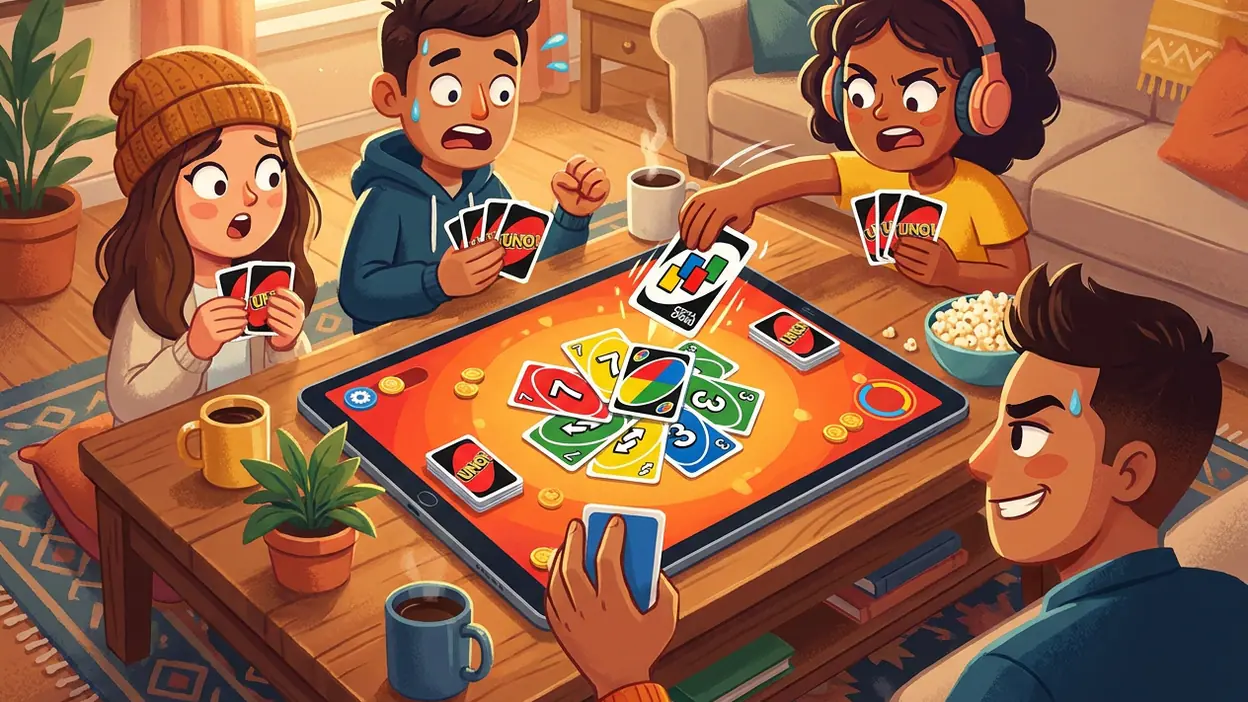
UNO! Review: Why One Last Card Still Makes Every Match Matter

The best mobile games do not need to make a world feel bigger. They need to make a small moment matter. UNO!™ understands that the last card in your hand can carry the weight of an entire match: a breath held over the draw pile, a rival one move from victory, a Wild card waiting to turn the table. Its premise is familiar, but its real achievement is making that old family-table tension feel immediate and repeatable on a phone.
This is a digital version of a game almost everyone already knows, and that familiarity is its greatest advantage. There is no elaborate tutorial to clear, no sprawling map to learn, no elaborate campaign to explain why the next round matters. You see the colors, read the cards, and make a choice. Then someone changes the color you were counting on, or drops a Draw Four at precisely the wrong time, and the clean little plan you had vanishes. The game’s drama is legible at a glance, which makes it unusually well suited to short sessions.

See More Apps Related to UNO!™


Why this card game deserves the spotlight
UNO! earns attention not by reinventing its rules but by recognizing what makes them endure. The central loop is a compact argument between patience and nerve. Do you spend a useful action card now to protect your lead, or hold it for the moment when the match is turning against you? Do you change the color to suit your hand, or to strand the player who looks closest to going out? Even a plain number card can become a calculated move when the table is down to its final few turns.
The game’s mobile format also changes the social texture without erasing it. A physical game depends on who is sitting around the table; here, online matchmaking can put you against unfamiliar players almost immediately. That can make each round feel brisk and unpredictable. The visual cues keep the action readable, while reactions and the familiar call to declare your final card preserve a little of the performance that makes UNO entertaining in person. You are not merely sorting colors. You are trying to get inside the rhythm of a table you have just joined.
That combination gives the game a rare kind of accessibility. A newcomer can understand the objective almost instantly, while an experienced player still has meaningful decisions to make. The rules are simple; the timing is not. This distinction is why a round can be both casual and surprisingly absorbing.
What feels exceptional from the first hand
The opening minutes are all about clarity. Cards are large enough to read, colors are easy to distinguish, and the game keeps the central question in view: what can you play, and what will it do to the next person? That directness matters on a small screen. Card games can become fussy when their interfaces bury the hand beneath menus or make routine actions feel like admin. UNO! keeps the focus on the table and lets the consequences do the talking.
Its pacing is another strength. Turns arrive quickly, and the game rarely asks you to wait long before you have something to decide. A round gathers speed as hands shrink. Early turns are about establishing a workable color and saving useful options; late turns become a close study of the discard pile, the remaining players, and the single card you hope to play next. The shift happens naturally, without a dramatic announcement. Suddenly, every draw feels personal.
Worth Reading Next

Why WhatsApp Messenger Is Your Go-To Communication App

Tile Club - Match Puzzle Game: A Fresh Spin on Classic Challenges

How Waze Transforms Navigation with Big Tech Power

Mastering Google Sheets: Unlock Hidden Features for Power Users

How Uber's Ride Request App Transformed Urban Mobility
More From Our News Desk
View All


That is the hook at its best: simple rules creating genuinely tense choices. A stack of penalty cards can make the match feel cruel, but it also gives the next player a reason to fight back. A color change can rescue a hand or expose a weak one. The game does not need a complicated combat system to create a sense of risk. It has one card, one turn, and a table full of people hoping you make the wrong call.
How it earns long-term attention
UNO! is built around replay rather than a single grand destination. Matches are short enough to fit between other tasks, and their outcomes are volatile enough that a loss rarely feels like a final verdict. You can be outplayed, outdrawn, or simply caught without the right color. The next round offers a clean reset, but not a completely empty one: you bring your frustration, your confidence, and perhaps a small desire to repay the player who just reversed the flow of the game.
That compact loop makes the game easy to revisit, though it is not the same as deep strategic progression. The core rules remain the attraction, and repetition can flatten the experience if you are looking for a campaign, a story, or a steadily expanding set of mechanical challenges. Its staying power depends on how much pleasure you take in reading the room and watching chance disrupt a plan. For the right player, that is plenty. For someone who needs every session to introduce something new, it may not be.
Modes and social features help vary the setting around that core, while online play supplies the essential unpredictability. Playing with people you know has a different flavor from joining a public match: familiar rivalries make every penalty card feel pointed, while strangers make the outcome harder to anticipate. The game’s best kind of progression is social. You learn who holds a Wild card too long, who changes color at the first opportunity, and who always seems to find a way out with one card left.
The best moments happen near the finish
UNO! is at its most vivid when a hand becomes a small crisis. You have one card left, but the color has just changed. The player before you has drawn rather than helped you. Someone across the table appears ready to finish, and your options suddenly narrow to a single imperfect move. That is when the game’s basic design earns its keep: there is enough information to make a choice, but never enough certainty to feel safe.
Some of the strongest sessions are not clean victories. They are the rounds where a lead evaporates, a penalty card lands at the worst possible moment, and you claw back into contention through a timely change of color. The emotional range is modest but sharply defined: relief, irritation, suspicion, delight. Because the rounds are brief, those feelings do not have time to become exhausting. A reversal can sting; a rematch is already within reach.
There is also a pleasing rhythm to the game’s social comedy. A move can be perfectly legal and still feel like a personal insult. A well-timed action card can make you look clever, while the exact same play against you can seem unforgivable. UNO! knows that the fun is partly in this mock outrage. It gives players a structured excuse to be competitive without asking them to take the competition too seriously.
Its edge over louder mobile rivals
Many mobile games compete for attention with spectacle: larger maps, louder effects, more elaborate progression, and sessions designed to stretch. UNO! wins by asking for less. It does not need to keep you immersed in a vast fictional world. Its arena is the hand in front of you, and its tension is social rather than cinematic. Compared with action-heavy games such as Free Fire, it is a quieter proposition, but not a passive one. A round can be every bit as urgent when a single card determines whether you stay in the match.
That restraint is a real editorial strength. The game’s familiar rules do not require you to learn a new language of buttons or systems before play can begin. It can fill a short break without insisting that you commit the whole evening. More importantly, it has a point of view about what makes play enjoyable: quick decisions, readable consequences, and the chance to turn a bad position around. The result feels less like a machine demanding attention and more like an invitation to one more hand.
Where it still needs polish
Familiarity can become a limitation. Once the basic rhythm is established, the central game does not transform dramatically, and players who want a broad single-player journey may find the experience thin. The chance-driven swings are part of UNO’s identity, but they can also make a hard-fought round feel decided by the draw rather than by judgment. That tension is entertaining in moderation; it is less satisfying when you are looking for a sense of mastery.
The social layer asks for restraint, too. Reactions and competitive gestures can add character, but any online game built around quick matches risks turning playful friction into noise. The best sessions are the ones where the table’s energy supports the cards rather than distracting from them. I would also like the game to make its different ways to play feel consistently easy to evaluate, so a returning player can choose a mode for its character instead of having to explore by trial and error. These are polish issues, not reasons to dismiss the core game, but they shape how welcoming the experience remains over time.
Most importantly, the game is strongest when it lets the rules carry the fun. If surrounding systems begin to demand more attention than the hand itself, the elegant simplicity that makes UNO work starts to blur. The right balance is clear: keep the table lively, but never make getting to the next good round feel like a chore.
Who should care most, and why now
UNO! makes the most sense for players who want a game that can be learned in seconds and enjoyed in company, whether that company is a group of friends or a room of online strangers. It suits short breaks, casual rivalries, and anyone who enjoys the tiny strategic decisions hidden inside simple rules. It is also a natural pick for people who already love the physical card game and want that familiar ritual close at hand.
It is a less obvious choice for players who need a story, a long-term build, or complete control over outcomes. This is a game about making the best of what you draw and staying alert to what everyone else might do. The unpredictability is the point, but it will not appeal to anyone who wants every win to feel like a precise demonstration of skill.
That balance feels especially relevant now, when mobile games often ask players to master sprawling systems or give over long stretches of time. UNO! offers another kind of value: a complete little contest that can begin quickly, turn tense, and finish before it outgrows its welcome. It does not confuse scale with importance. A handful of cards and a few opponents are enough to produce a story worth finishing.
My verdict is straightforward: UNO! is one of mobile gaming’s most dependable social card games, and its best rounds still have the snap of a great table match. It can be repetitive, and luck sometimes gets the last word, but the clarity, pace, and mischievous pleasure of its final turns remain remarkably hard to replace. If you want a quick game with real human friction and an honest reason to say “one more,” this is an easy recommendation.