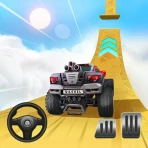
DUST: Dirt ATV Offroad Racing
For Android
DUST: Dirt ATV Offroad Racing is the kind of racing game I open when I want a quick burst of rough-terrain driving rather than a deep motorsport simulator. Its focus is clear: an ATV quad bike, dirt, mud, and off-road racing. That narrow identity is useful because I know what I am getting into, but it also means the game needs to feel good immediately. If the controls or loading process create friction, there is not much else here to distract me from it.
Developed by Vira Games Inc., this free racing game is aimed at a broad audience, with an Everyone content rating. It arrived on May 28, 2026, and the current version is 1.0.9. The store summary sets the expectation for an extreme off-road experience, while the short description simply uses “DUST.” I read that as a deliberately direct pitch: this is about getting onto the track and dealing with the messy, loose-surface character of ATV racing.
Getting past the first points of friction
What can make the opening feel harder than the race
With a game built around quick racing, the first few minutes matter more than they do in a slower strategy or puzzle title. I want to reach the driving section without having to make many decisions first. If the opening feels confusing, I recommend taking a moment to identify the basic driving input before trying to race aggressively. On a muddy course, steering corrections are likely to matter more than simply holding a direction, so beginning with small movements is a better test than immediately pushing for maximum speed.
One practical mistake is judging the game after a single awkward turn. Off-road racing has a different rhythm from clean asphalt racing. A quad bike can feel less predictable when the surface is loose, and a player who is used to sharp, instant steering may overcorrect. I found it more useful to treat the first attempt as a handling check: notice how much input is needed for a bend, how quickly the ATV responds, and whether braking before a corner is more reliable than trying to turn while accelerating.
Another common sticking point is expecting the title to behave like a full racing simulator. That is not the right comparison. The appeal here is the immediacy of an ATV on dirt, not the detailed tuning or competitive structure I would expect from a larger racing package. If I approach it as a compact off-road game, its straightforward design makes more sense. If I expect extensive vehicle management, a long career, or the depth of a major console-style racer, I am likely to feel limited.
How I approach a first run
My preferred opening routine is simple. I begin slowly, learn the steering response, and use the first clean section of track to see how much momentum the quad bike carries. I avoid making several changes at once. For example, turning sharply, accelerating hard, and trying to recover from a missed line can make it difficult to tell whether the problem was control sensitivity or poor timing.
That approach also helps with the visual challenge of dirt and mud. Off-road tracks can look visually similar from one section to the next, so I focus on the next meaningful bend rather than staring at the whole route. I keep my attention on the surface immediately ahead, prepare for turns early, and leave room to correct. This is a small habit, but it makes short sessions feel less random.
Players who enjoy arcade-style racing should find that learning process familiar. Players who prefer to win immediately may need more patience. The game works best when I accept that the first run is partly practice, especially if I am switching from a road-racing title with very precise grip and braking.
Checks worth making before blaming the game
Before deciding that a race is malfunctioning, I check the basics on my device. I make sure the game has finished installing, close other demanding apps, and restart it if the opening behaved strangely. I also check that the phone is not already struggling with heat or low available storage. These are ordinary steps, but racing games are sensitive to interruptions because a brief pause can ruin a turn even when the application itself is working normally.
The minimum operating-system requirement is Android 7.1, so compatibility begins there. That does not mean every device will provide the same experience. A phone that technically meets the requirement may still have older hardware, a crowded background workload, or a display that makes touch inputs less comfortable. I would therefore separate two questions: can the game install, and can the phone run it comfortably during a race?
I also recommend checking the device orientation and touch response before starting a serious attempt. If taps or swipes feel delayed elsewhere on the phone, the issue may not be specific to the game. Cleaning the screen, removing a poorly fitted protector temporarily, and avoiding play while the device is handling many background tasks can make the controls easier to judge.
Recovering a session when something goes wrong
A calm restart is often more useful than repeated tapping
If the game stops responding at launch or a race appears stuck, my first choice is to leave it alone for a moment rather than repeatedly tapping the screen. Repeated input can make it harder to tell whether the application is loading or simply ignoring commands. I close it normally when possible, reopen it, and try again with other apps out of the way.
You may also like

Amazon Kindle: Revolutionizing Digital Reading

Why OLX: Compras Online e Vendas Captivates Shoppers Worldwide

Unpacking the Strategy of Yalla Ludo's Jackaroo Mode

Why eBay's Mobile App Stands Out in Online Shopping

How Fishdom's Puzzle Mechanics Transform Your Aquarium Experience

Block Blast! The Perfect Puzzle for Busy Lives
If the same behavior returns, I restart the phone. That clears temporary system pressure without changing the game itself. I avoid jumping straight to clearing application data because that can remove local progress or settings, depending on how the game stores them. A restart is the safer first recovery step; more disruptive actions should come later and only when I understand what may be lost.
Network changes can also confuse troubleshooting. Even when the core driving experience seems like something I should be able to start quickly, an installation or update may still need a stable connection. I check whether the download completed properly and whether the connection is stable before trying repeated reinstalls. Switching between reliable Wi-Fi and mobile data can help identify whether the problem is the connection rather than the racing itself.
Separating control mistakes from control problems
When a quad bike repeatedly misses the same corner, I test the situation in a controlled way. I approach the bend at a lower speed, use a smaller steering movement, and repeat the line. If the result improves, the issue was probably timing rather than a broken control. If the input remains inconsistent across different parts of the screen, I inspect the phone’s touch behavior and screen protector before concluding that the game is at fault.
This is particularly important in an off-road game because the surface can encourage aggressive driving. Mud and dirt naturally suggest sliding, but sliding is only useful when I have room to recover. I prefer entering a turn with a little reserve rather than trying to force the ATV through at full speed. That trade-off is one of the more interesting parts of the experience: a cautious line may look slower but can produce a cleaner run than constant acceleration.
For touch players, I suggest keeping the phone steady and using the same grip from one attempt to the next. Changing how I hold the device changes how easily I can make small corrections. A stable grip is especially helpful during short sessions, when it is tempting to play one-handed or while walking. I would not recommend that; a moving player and a fast off-road course are a poor combination.
When reinstalling is reasonable
Reinstallation is a last resort for me, not the first response. I consider it when the game consistently fails after a restart, the installation seems incomplete, or a normal update has not resolved a launch problem. Before doing it, I check whether local progress might be affected. Since I do not want to lose a working setup just to solve a temporary issue, I use less disruptive steps first.
If I reinstall, I do it over a dependable connection, wait for the process to finish, and launch the game before opening several other applications. That gives me a clean test. I then play a short run rather than immediately changing every setting or starting a long session. A short test makes it easier to identify whether the original problem has actually disappeared.
When the phone or environment is the real problem
Not every poor session points to the game. Heat is a good example. A phone that has been charging, sitting in direct sunlight, or running several demanding apps may reduce performance or make touch input feel less comfortable. I get a fairer impression by playing on a cooler device with unnecessary apps closed.
Notifications can cause interruptions at precisely the wrong moment. For a focused race, I use the phone’s normal do-not-disturb tools when appropriate, while remembering that those settings belong to the operating system rather than the game. I also avoid judging the experience while a large download or system update is running in the background.
Storage pressure is another overlooked cause of trouble. Even if the game is already installed, a nearly full phone can behave poorly during updates or general use. Freeing a reasonable amount of space and restarting the device is a sensible maintenance step before assuming that DUST is unstable.
There is also the question of expectations. If I want a long, structured racing campaign, detailed vehicle customization, or a large online community, I may be looking for a different type of game. DUST is better suited to someone who wants the specific feel of ATV dirt racing and can accept a more focused experience. A conventional road racer will be a better choice for clean lap lines and grip-focused driving. A motocross title may be preferable for jumps and bike tricks. A simulation-oriented game will suit players who care more about tuning and realism than immediate off-road action.
Who will enjoy the short off-road sessions
I see the strongest use case as a quick break during an ordinary day. Suppose I have ten minutes before an appointment or while waiting for a friend. I can open the game, run a few attempts, and concentrate on improving one corner rather than committing to a long play session. The dirt-and-mud theme gives those short races a distinct identity, so it does not feel like another generic road racer.
It can also work for players who are new to racing games and want a simple entry point. The subject is easy to understand: ride the quad bike, handle the rough course, and try to complete a better run. The Everyone rating makes it suitable for a broad audience, although younger players may still benefit from an adult helping with device settings and download management.
More experienced racing fans can enjoy it as a change of pace, particularly if they like correcting slides and choosing safer lines. I would not recommend it as a replacement for a deep racing collection. Its value is in the focused off-road premise, not in offering every racing feature at once.
The audience size is still developing, with over fifty thousand installs and an average rating of three and a half from a few dozen ratings. That gives me a useful but limited signal: there is real interest, yet the public response is not broad enough for me to treat the rating as a definitive verdict. I would use the game’s free price as the practical reason to try it, not the rating alone.
Small habits that improve the experience
My first tip is to learn one section at a time. Instead of trying to perfect an entire race immediately, I focus on the first difficult bend, then the next one. This reduces frustration and reveals whether my problem is speed, steering, or simply looking too far ahead.
My second tip is to use failed attempts as information. If I leave the track after entering a corner too quickly, I repeat the approach with earlier braking. If I spin after a sharp input, I make the movement smaller. This is more effective than changing the strategy completely after every mistake.
My third tip is to separate performance testing from serious play. After an update or reinstall, I run a short session with the phone cool and background apps closed. Once that works, I return to normal play. That workflow prevents me from confusing a temporary device slowdown with a permanent game issue.
My fourth tip is to choose the game for the right mood. It is a good pick when I want direct, muddy ATV action and do not need a large amount of preparation. It is a poor pick when I want a polished competitive ladder, extensive customization, or a realistic racing model. Making that choice upfront saves more time than trying to force the game into a role it was not designed to fill.
My practical verdict
DUST: Dirt ATV Offroad Racing is worth trying if the idea of short, rough-surface quad-bike races appeals to you. I like that its identity is easy to understand and that the free price lowers the barrier to testing it. The best moments come from gradually finding a cleaner line through a muddy corner, managing speed instead of simply holding the accelerator, and seeing a previously awkward section become predictable.
At the same time, I would keep expectations measured. This is a focused racing game from Vira Games Inc., not a complete motorsport platform. Players seeking extensive systems or a highly technical simulation should choose a more specialized alternative. Players who dislike repeating a corner to learn its timing may also lose interest quickly.
The current version, 1.0.9, is the one I would use as the starting point, and I would make sure the device meets the Android 7.1 minimum before troubleshooting anything deeper. If launch problems appear, I would begin with a stable installation, a restart, a cool device, and fewer background tasks. Those checks solve many everyday issues without risking local progress.
My final recommendation is therefore selective but positive. Try it when you want an accessible off-road racing break, especially if dirt and ATV handling sound more interesting than another polished asphalt circuit. Skip it when you need deep progression, detailed setup, or a broad competitive ecosystem. For the right player, its uncomplicated mud-focused approach is exactly the point.
Pros
- Responsive ATV controls make drifting and jumps easy to learn.
- Short races fit well into quick gaming sessions.
- Off-road tracks offer varied terrain and challenging obstacles.
- Vehicle upgrades provide a clear sense of progression.
- Offline play is useful when there is no internet connection.
Cons
- Frequent crashes can make progress feel repetitive over time.
- Some upgrades may require considerable grinding to unlock.
- The camera can become awkward during sharp turns and jumps.
- Track variety may feel limited after extended play.
- Ads can interrupt the experience
- especially between races.
FAQ
What is DUST: Dirt ATV Offroad Racing?
DUST: Dirt ATV Offroad Racing is an off-road racing game focused on ATV riding across rough, dusty tracks. Players compete through challenging environments filled with jumps, sharp turns, uneven terrain, and obstacles. The game emphasizes fast driving, vehicle control, and improving performance as you progress through races and unlock more demanding courses.
Can I play DUST: Dirt ATV Offroad Racing offline?
DUST: Dirt ATV Offroad Racing may allow some racing features to be played without a constant internet connection, which is useful when traveling or using limited mobile data. However, certain functions, such as advertisements, updates, online competitions, cloud synchronization, or other connected features, may require internet access. It is best to launch the game online first and check which modes remain available offline.
Is DUST: Dirt ATV Offroad Racing suitable for beginners?
The game is accessible to beginners because the basic objective is easy to understand: control your ATV, stay on the track, and finish races as quickly as possible. Nevertheless, the uneven terrain and jumps require practice, especially when landing or taking corners at high speed. New players should begin with easier events and gradually learn acceleration, braking, and steering control.
Does the game include ATV upgrades or customization?
Progression in an off-road racing game is usually connected to improving the vehicle, and DUST: Dirt ATV Offroad Racing gives players reasons to continue racing by working toward better performance and additional content. Depending on the version and available game modes, upgrades or customization may affect areas such as speed, handling, acceleration, or stability. Check the in-game garage for the exact options.
Is DUST: Dirt ATV Offroad Racing free to download and does it contain ads?
DUST: Dirt ATV Offroad Racing can generally be downloaded without an upfront purchase, but free mobile games commonly support themselves through advertising, optional purchases, or both. Ads may appear between races or when claiming certain rewards, while purchases can sometimes speed up progression or provide extra content. Review the store listing and the game’s purchase settings before downloading, especially on a shared device.