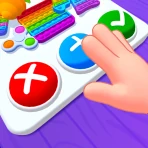
Pop Us!
For Android
Pop Us! is the kind of small game I open when I want my hands busy without committing to a story, a strategy session, or a difficult challenge. It belongs to the simulation category, although its appeal is much simpler than that label might suggest: you interact with colorful pop-style objects and work through short, satisfying moments at your own pace. I found it easy to understand almost immediately, which is exactly what I want from a casual anti-stress game.
That simplicity is also the key to deciding whether it is right for you. This is not a deep simulator, and it is not trying to replace a full puzzle game. It is better viewed as a quick tactile distraction for waiting rooms, short breaks, or those moments when I want something cheerful but do not want to think too hard. The game is free, carries an Everyone age rating, and is made by SayGames Ltd.
How the game feels during ordinary play
The first thing I noticed was how quickly Pop Us! gets out of the way. There is no long learning period to endure before the basic interaction becomes clear. The central appeal comes from popping colorful shapes and enjoying the immediate response, so the game communicates its purpose through touch rather than through complicated instructions.
That makes the perceived speed feel good during short sessions. I can pick it up, complete a small amount of play, and put it down without needing to remember a complicated objective. For someone checking a phone while a kettle boils or while waiting for a friend, that low commitment matters more than a large feature list.
The game also benefits from a steady rhythm. Each interaction feels like a small action with a visible result, and that creates a pleasant loop: look, tap, clear or progress, then continue. I would not describe it as intense, but it is responsive in the way a casual touch game needs to be. The experience is built around the feeling of completion rather than suspense.
One useful way to approach it is to treat each short session as a reset rather than a serious gaming appointment. I found that expectations make a big difference. If I opened it hoping for complex simulation systems, I would be disappointed. If I opened it for a colorful few minutes of repetitive interaction, it made much more sense.
Why the simple interaction works
Many games in this area add timers, elaborate progression, or increasingly demanding puzzles. Pop Us! keeps its main attraction close to the surface. That makes it approachable for younger players and for people who rarely play games, while still giving experienced mobile users something immediately understandable.
The tactile focus is especially useful when I am mentally tired. A conventional puzzle can become another task to solve, while this game feels more like a light activity. It does not require me to plan several moves ahead or remember a complicated set of rules. That is a genuine strength, not a missing feature, because the whole point is to reduce friction.
There is also a practical benefit for shared devices. Since the age rating is Everyone, the game is easier to consider for a family phone or for a child who wants a simple colorful activity. I would still supervise younger children in the normal way, particularly around optional purchases, but the basic concept is accessible enough for a wide audience.
What happens when I play for longer
The biggest trade-off appears during extended sessions. A game based on one clear interaction can feel repetitive once the novelty wears off. I enjoyed it more in several short visits than in one long stretch, because the popping action remains pleasant when it is used as a break but becomes less distinctive when I expect constant surprise.
This is where Pop Us! differs from a traditional puzzle title. A match-three game, physics puzzler, or management simulator usually asks me to make decisions that change the outcome. Here, the satisfaction comes more from completing the immediate activity. Players who need strategic depth, a strong narrative, or a long-term challenge should look elsewhere.
That does not make the game shallow in a negative sense. It simply gives it a narrower purpose. I would recommend it to someone who wants a calming, colorful touch experience, but I would not present it as a game that will occupy an entire evening for weeks.
You may also like

Amazon Kindle: Revolutionizing Digital Reading

Why OLX: Compras Online e Vendas Captivates Shoppers Worldwide

Unpacking the Strategy of Yalla Ludo's Jackaroo Mode

Why eBay's Mobile App Stands Out in Online Shopping

How Fishdom's Puzzle Mechanics Transform Your Aquarium Experience

Block Blast! The Perfect Puzzle for Busy Lives
Speed, stability, and heavier use
What to expect from everyday responsiveness
For normal play, the design suggests a light workload: the screen is focused on simple colorful interactions rather than a large world, complex simulation, or demanding multiplayer activity. In my experience, that makes the game feel suited to quick launches and brief sessions. The important performance question here is not whether it delivers console-level graphics; it is whether the basic tap-and-pop rhythm feels immediate enough to stay satisfying.
That expectation is generally reasonable for a game of this style. There is no reason to approach it as a technically demanding title. I would install it for its accessible interaction, not for visual effects that push a phone to its limits. On a reasonably maintained device, the lightweight presentation should be more comfortable than a modern 3D game with large environments and constant asset loading.
Still, perceived speed is not only about graphics. A crowded storage drive, an older operating system, background activity, or a device that is already warm can affect any mobile game. If the game feels less responsive, I would first close other demanding apps, check available storage, and restart the phone before deciding that the game itself is at fault.
When longer sessions may feel different
Short bursts are the natural use case, but heavier use can expose ordinary mobile limitations. Keeping any game open repeatedly can increase battery use compared with simply reading a message or leaving the screen off. The colorful presentation may also be more noticeable on a small battery than on a newer phone with plenty of capacity.
I would not install it expecting it to be invisible in the background or completely free of resource demands. The sensible habit is to play with a comfortable battery level, especially when traveling. If I am trying to conserve power, I would choose a brief session and close the game afterward rather than leaving it active while switching between other apps.
Another practical point is heat. A short casual game session should not be treated like a benchmark, but any phone can warm up when several apps are active or when it is charging during play. If the device becomes noticeably hot, stopping for a while is the better choice. That advice is not specific to Pop Us!, but it matters when judging whether a game fits a particular routine.
Recovery after interruptions
Casual games are often used in interrupted situations, so recovery matters. I am more forgiving of a game that lets me return quickly after a phone call or a brief switch to another app than one that expects a long uninterrupted session. Pop Us! is naturally suited to this kind of stop-and-start use because its core activity is easy to understand again.
My practical advice is to avoid treating an unfinished moment as a major loss. If I need to answer a message, lock the screen, and return later, the game’s simple structure makes it less stressful than a timed competitive match. That is one of its quiet advantages: the experience fits around real life instead of demanding that real life fit around it.
At the same time, I would not promise perfect recovery in every situation. Phones can close apps when memory is tight, systems can restart processes, and device behavior varies. If a session matters to you, keep the phone in a stable state and avoid opening several heavy apps at once. The game’s casual nature makes recovery less important than it would be in a long story campaign, but it is still worth considering.
Device requirements and practical limits
The game supports devices running Android 8.0 or later. That gives it a useful range across older and newer Android phones, although operating-system support alone does not guarantee identical results on every model. Screen size, touch sensitivity, free storage, battery condition, and the number of apps competing for memory can all change how comfortable it feels.
On a compact phone, the colorful objects may feel more concentrated and the touch targets may require a little more care. On a larger display, the interaction can feel more relaxed, but the game may also become less convenient to use with one hand. I would choose the device based on where I plan to play: a small phone is practical for quick breaks, while a larger screen may be nicer for shared casual use.
People using very old hardware should keep expectations sensible. The minimum operating-system requirement is not the same as a guarantee of identical smoothness across every supported device. If your phone already struggles with basic animations or frequently reloads apps, Pop Us! may not be the best test of its limits. A clean restart and some free storage can help, but hardware constraints remain hardware constraints.
For iPhone users, the important decision is less about raw specifications and more about whether the game’s simple format matches their habits. I would choose it on either mobile platform for the same reason: it offers a quick, colorful activity rather than a demanding long-form game. The best device is the one that responds comfortably to taps and is available when you need a short distraction.
Cost, optional spending, and who should install it
Pop Us! is free to download, which makes it easy to try without making a financial commitment. Optional in-app purchases are listed at $1.99 per item. I would approach those purchases carefully, especially if the game is being used by a child or on a shared family device. The free entry point is enough to decide whether the basic interaction works for you before spending anything.
This pricing structure suits the game’s casual role, but it also means I would not judge the experience solely by the fact that it costs nothing. Free games can still ask for attention, storage, and patience. Before installing, I would consider whether I actually enjoy repetitive touch interactions, because no optional purchase can turn this into a deep strategy game if that is what I am looking for.
The game is a good fit for commuters, families, casual players, and anyone who likes simple sensory feedback. It is less suitable for someone who wants competitive rankings, detailed customization, a story campaign, or a simulation with systems that develop over time. If your favorite mobile games are city builders or complex puzzle adventures, this may feel more like a palate cleanser than a main game.
How it compares with other casual choices
Compared with match-three games, Pop Us! asks for less planning and offers a more direct physical interaction. That makes it easier to start but potentially less rewarding for players who enjoy building combos or solving increasingly difficult boards. Compared with idle games, it gives me something active to do instead of relying on passive progress. Compared with relaxation apps, it is more playful, though it is still based on repetition rather than guided meditation or structured breathing.
That comparison helps clarify its place. I would choose Pop Us! over a puzzle game when I want low mental effort, and over an idle title when I want to tap and see an immediate result. I would choose a more substantial alternative when I have a long journey, want meaningful progression, or need a game that remains interesting after many consecutive sessions.
One of the more useful ways to use it is as a transition tool. After finishing work, I can play briefly before moving to another activity, giving my attention a simple place to settle. It also works during small gaps that are too short for a full level in a story game. Those situations reveal its strongest quality: it respects limited time.
For example, if I am waiting for an appointment, I can open the game, play for a few minutes, and stop without feeling that I abandoned a complicated objective. If the appointment begins unexpectedly, the cost of leaving is low. That is a better everyday scenario for this game than planning a long evening around it.
My performance verdict
After weighing its speed expectations, heavier-use trade-offs, recovery needs, and device requirements, I see Pop Us! as a deliberately light casual game rather than a technical showcase. Its straightforward interaction should be comfortable for ordinary short sessions, while the main limitation is not demanding graphics but repetition. The game’s performance value comes from being easy to approach and easy to leave.
The rating of 4.3 from around 46 thousand ratings and more than a thousand written reviews suggests that many players find the concept appealing, while the audience of over 50 million installs shows how broadly the format has traveled. Those figures do not change my personal conclusion, but they do place the game in the familiar, widely used corner of mobile gaming rather than the experimental niche.
The current version is 1.1.60, and the game was released on June 24, 2021. I mention those details because they help identify the version and age of the product when you are deciding whether it fits your phone, but the more important question is still personal: do you enjoy quick tactile repetition?
My honest recommendation is to try it when you want a colorful, low-pressure break, not when you want a deep game. The free download removes much of the risk, and the Everyone rating makes the basic concept broadly approachable. I would keep optional spending under control, avoid marathon sessions if repetition starts to show, and give older devices a little breathing room by closing unnecessary apps.
In the end, Pop Us! succeeds because it does not ask me to become invested before it becomes enjoyable. I can open it for a small moment of calm, get the satisfaction of completing simple interactions, and move on. That will not satisfy every player, but for the right use case it is exactly the point. If you want a gentle pocket distraction that feels more interactive than passive scrolling, I think it is worth trying.
Pros
- Simple drag-and-drop gameplay is easy to learn.
- Short levels make it suitable for quick gaming sessions.
- Colorful bubble designs create a cheerful visual style.
- Relaxing mechanics provide a low-pressure puzzle experience.
- Works well for players who enjoy sorting and matching challenges.
Cons
- The gameplay can become repetitive after extended play.
- Some levels may feel too easy for experienced puzzle fans.
- Progression may lack depth for players seeking complex strategy.
- Ads can interrupt the experience in the free version.
- Limited variety may reduce long-term replay value.
FAQ
What is Pop Us! and how is the game played?
Pop Us! is a casual puzzle game centered on popping colorful bubble-like shapes. The main interaction is simple: tap or press the pieces to clear them and complete each level or pattern. As you progress, the layouts become more demanding, requiring better timing, attention, and planning. It is designed for short play sessions and offers an easy-to-understand experience for both children and adults.
Is Pop Us! free to download and play?
Pop Us! can generally be downloaded for free, allowing players to try the core gameplay without paying upfront. However, the app may include advertising, optional purchases, or other monetization features depending on the version and platform. Before downloading, it is worth checking the store listing for current details about in-app purchases, subscription terms, and whether certain content or benefits require payment.
Does Pop Us! require an internet connection?
The basic popping and puzzle mechanics in Pop Us! may be available without a constant internet connection, which makes the game convenient for travel or quick offline sessions. Nevertheless, some functions—such as displaying advertisements, synchronizing progress, downloading updates, or accessing online features—can require connectivity. Availability may also differ between Android and iOS versions, so offline behavior should be verified on your device.
Is Pop Us! suitable for children?
Pop Us! uses simple controls, bright visuals, and casual puzzle mechanics, so it can be approachable for younger players. Parents should still review the age rating and privacy information shown on the relevant app store. If the game contains advertisements or optional purchases, parental controls are recommended, especially on shared devices. The difficulty and presence of promotional content may vary by version.
Are there many levels or challenges in Pop Us!?
Pop Us! is intended to provide repeated casual play through a collection of popping puzzles and progressively changing challenges. The exact number of levels, available modes, and difficulty progression can depend on the current release. Players should expect a straightforward experience focused more on relaxation and quick challenges than on a complex story. Updates may add, adjust, or reorganize content over time.