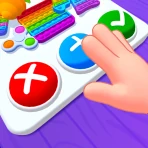
I Am Dino
For Android
I Am Dino is an unusual name for a game whose store summary presents me as a mischievous monkey prankster. That contrast is the first thing I noticed, and it also sets the tone for the experience: this is a light simulation game built around playful trouble rather than serious management or competition. I played it expecting a quick, easygoing diversion, and that is where it makes the most sense. It is free, rated for Everyone, and developed by CozyTap Studio, so the overall presentation is clearly aimed at broad accessibility rather than a demanding specialist audience.
My first impression was that the game wants me to enjoy the idea of being a cheeky character more than it wants to bury me under complicated rules. That makes it approachable when I only have a short break, but it also means the quality of the experience depends heavily on whether the prankster premise keeps feeling fresh. If you want a deep simulation with carefully layered economics, long-term planning, or a large strategic sandbox, this is probably not the right place to start. If you want a simple, humorous game that is easy to pick up, it has a more convincing case.
How the early goals establish the game
The opening stretch works best when I treat it as a gentle introduction to the game’s central fantasy. I am not stepping into the role of a city planner, farmer, or business owner. Instead, I am playing around the idea of causing harmless mischief as a monkey. That gives the early moments a clear identity, even though the concept is much lighter than the usual simulation formulas.
What matters here is the immediacy of the objective. A good early goal should tell me what to do without making me study a manual, and I Am Dino benefits from that simplicity. The game is easier to approach than simulations that begin with several currencies, menus, upgrade trees, or production chains. I can focus on understanding the prankster role instead of learning a complicated interface first.
That simplicity is also the first trade-off. The early goals are more useful for getting me comfortable than for testing my planning skills. Players who enjoy discovering an efficient route through a complex system may find the opening too gentle. Players who usually abandon simulation games because they feel like spreadsheets in disguise will likely appreciate the lower barrier.
I would recommend starting with a short session rather than expecting a long campaign immediately. The game’s appeal is easier to judge when I allow its playful premise to work on its own terms. It is not trying to replace a detailed management simulator. It is closer to a casual experiment in mischievous play, and expecting a heavier structure would make the first impression less fair.
What progress feels like during the first sessions
The most important progress signal is whether my actions feel connected to the game’s playful purpose. In a simulation, I want more than movement or tapping; I want to understand why the next action matters. Here, the monkey-prankster theme gives those actions a recognizable context. Even a small step feels more satisfying when it supports the joke or the role I am playing.
At the same time, I would not call the progression especially demanding. The game is designed to be welcoming, and that affects the rhythm. I am not constantly forced to make difficult decisions, and the experience does not seem built around punishing mistakes. That makes it suitable for younger players and for anyone who prefers relaxed play, but it reduces the sense of achievement for experienced simulation fans.
One useful way to approach the progress is to watch for changes in what the game asks me to notice. At first, I am learning the basic interaction and the tone. Later, I am paying more attention to timing, the consequences of a prank, and whether the next objective changes how I approach the same situation. This is a better measure of engagement than simply asking whether the game has a large number of unlocks. A small game can remain enjoyable if each step changes my decision-making, while a large one can feel empty if every step is identical.
I also found that the game works better as a shared conversation starter than as a solitary achievement project. Showing someone the premise, handing over the device, or discussing the funniest approach can add energy that the basic progression may not create by itself. That makes it a natural fit for a quick family break, provided the player understands that the challenge is intentionally approachable.
Difficulty, pacing, and the point where interest may dip
The difficulty curve is gentle, which is consistent with the Everyone age rating. I do not approach each new moment expecting a severe penalty or a complicated puzzle. That can be a strength when I want to relax, especially after work or during a short pause between errands. I can play without preparing for a long, uninterrupted session.
The weakness is that gentle difficulty can make the middle of a game feel less urgent. If the next objective does not ask me to rethink my habits, progress can become routine. In I Am Dino, the central question is not whether the game is difficult in the traditional sense. It is whether the prankster idea continues to provide enough variety to make another session worthwhile.
You may also like

Amazon Kindle: Revolutionizing Digital Reading

Why OLX: Compras Online e Vendas Captivates Shoppers Worldwide

Unpacking the Strategy of Yalla Ludo's Jackaroo Mode

Why eBay's Mobile App Stands Out in Online Shopping

How Fishdom's Puzzle Mechanics Transform Your Aquarium Experience

Block Blast! The Perfect Puzzle for Busy Lives
This is where I think expectations matter most. A player looking for a calm, accessible simulation may see the relaxed pace as the main attraction. A player who wants escalating pressure, tight resource management, or increasingly complex goals may feel that the game stops short. Neither reaction is wrong; they reflect two different reasons for playing.
My practical advice is to play in compact sessions and judge the game by the quality of its individual moments rather than by the length of a single sitting. The premise is better suited to quick returns than to marathon play. When I tried to demand a long, constantly escalating experience from it, the lighter structure became more noticeable. When I treated it as a small diversion, the pacing felt more appropriate.
Another trade-off concerns attention. Because the game is approachable, it can be a good choice when I do not want to memorize systems. But that same accessibility means it may not hold the attention of someone who needs a strong mastery curve. If your favorite simulations are built around optimization and increasingly difficult decisions, a more specialized alternative will probably give you more to analyze.
Does the game create enough reason to return?
Retention in a casual simulation should come from curiosity and satisfying goals, not from making the player feel trapped into checking in. I Am Dino is at its best when I return because I want another playful interaction, not because I am worried about falling behind. That is a healthier fit for a relaxed game, particularly for families or players who dislike aggressive pressure.
Still, the question of long-term motivation is important. A mischievous monkey is a strong starting idea, but a starting idea is not automatically a complete progression system. I need the game to keep giving me a reason to experiment, improve, or discover something new. If the available goals begin to feel like variations of the same action, the novelty can fade even when the controls remain easy.
I would describe the retention pressure as mild. The game does not present itself as a serious commitment, and that is welcome. I can put it down without feeling that I have damaged a carefully built plan. The downside is that it may not create the kind of daily habit associated with deeper simulation games. For me, that makes it easier to live with but less compelling as a primary game.
There is also a useful distinction between replayability and convenience. A game can be convenient because it starts quickly, while still offering limited reasons to repeat the same activity. I Am Dino benefits from convenience, but I would not choose it solely because I expect endless depth. Its strongest use case is a short burst of playful interaction, especially when I want something less demanding than a strategy title.
For a realistic everyday scenario, imagine waiting for an appointment or taking a short break after finishing household tasks. This is the kind of moment in which I would open the game, try a few objectives, and put it away without needing to remember a complex plan. It also works as a casual handoff between friends or family members: one person can try a prankster action, explain the basic idea, and let the next person take over. That social, low-pressure use is more convincing to me than treating it as a long-term competitive challenge.
Who will enjoy it, and who should skip it?
I think I Am Dino is a good fit for players who prefer simple simulation games with a humorous identity. It is also suitable for someone who wants an accessible title for occasional play, or for a younger audience covered by the Everyone rating. The free price removes the biggest barrier to trying it, and the broad compatibility helps as well: the game supports devices running Android 7.1 or later.
The current version is 1.0.0, which is worth keeping in mind when deciding how much depth to expect from the experience today. I would approach it as a focused, early version of its idea rather than assuming it already offers the breadth of a long-established simulation series. That does not make it a poor choice; it simply makes the right expectations more important.
I would skip it if your priority is a detailed economy, elaborate construction, serious survival pressure, or a progression system that constantly introduces new layers. I would also look elsewhere if you need a game that rewards long planning sessions and precise optimization. The monkey-prankster concept is more playful than strategic, and the relaxed pacing will not satisfy everyone.
Compared with the usual alternatives in the simulation category, this game stands out through its character-driven mischief rather than through realism or management depth. Many simulation games ask me to build, organize, operate, or maintain something. I Am Dino asks me to enjoy a playful role. That makes it less suitable for players seeking a serious virtual job and more suitable for players who want a simple fantasy with a comic edge.
The comparison also explains its biggest limitation. A conventional management simulator can keep me engaged through budgets, layouts, upgrades, and long-term efficiency. This game has to rely more on the charm of its central idea and the satisfaction of its immediate objectives. If that charm lands for you, the lighter structure feels refreshing. If it does not, there may not be enough complexity underneath to compensate.
What the audience response suggests
The game has an average rating of 4.3 from around one thousand ratings, alongside more than one million installs. Those figures suggest that the accessible concept has reached a substantial audience and that many players have responded positively enough to rate it. I would read that as encouragement to try it, not as proof that it will match every player’s preferred style.
A broad audience can include very different expectations. Some people may value the quick, playful premise, while others may want more demanding progression. That is why I would pay more attention to my own preferred pace than to the rating alone. The response supports the idea that this is an approachable game, but it does not turn it into a deep simulation by itself.
The free model is especially relevant here. I can test the basic loop without making a purchase decision first, which makes the game easier to recommend as a low-risk experiment. For a child, a casual player, or someone curious about the monkey-prankster concept, that matters. For a dedicated simulation fan, the lack of upfront cost does not remove the need to ask whether the goals remain interesting over time.
My progression verdict
After spending time with I Am Dino, I see it as a compact, friendly simulation game whose main strength is its unusual playful identity. The early goals are easy to understand, the difficulty is welcoming, and the pacing suits short sessions. I like that I can approach it without preparing for a complicated system or a stressful commitment.
Its progression is less convincing when I ask it to support a long, demanding routine. The game’s central joke and role-playing premise do much of the work, so players who need frequent strategic escalation may reach its limits sooner. That is not a reason to reject it outright; it is a reason to use it for what it does best.
My recommendation is simple: try it when you want a free, low-pressure prankster simulation, not when you are searching for a full management game. CozyTap Studio has chosen accessibility over complexity, and that choice gives the game a clear audience. I would hand it to a friend who enjoys quick humorous diversions, especially one who finds traditional simulation games too serious. I would not recommend it as a replacement for a deep strategy simulator.
In the end, I Am Dino succeeds when I let its mischievous tone lead the experience. Its goals and progression are most enjoyable as small invitations to play rather than as steps in an ambitious mastery system. The result is easy to start, easy to share, and easy to leave without pressure. Whether that feels pleasantly focused or too limited will depend on how much depth you expect from a simulation game.
Pros
- Simple controls make it easy for younger players to pick up.
- Bright dinosaur visuals are appealing and easy to understand.
- Short sessions work well for quick entertainment.
- Offline play is convenient when no internet connection is available.
- Progression gives players a reason to return and keep improving.
Cons
- Gameplay may feel repetitive after extended play sessions.
- Some levels can become frustrating without careful timing.
- The visual style may seem too basic for older players.
- Limited variety can reduce long-term replay value.
- Ads or optional purchases may interrupt the overall experience.
FAQ
What is I Am Dino, and what can I do in the app?
I Am Dino is a dinosaur-themed mobile experience focused on exploring a prehistoric world and interacting with dinosaur content. Depending on the version available for your device, you may be able to discover different creatures, complete activities, and enjoy simple gameplay designed for casual sessions. Before downloading, check the store description and screenshots because features can vary between Android and iOS releases.
Is I Am Dino suitable for children?
I Am Dino may appeal to children and dinosaur fans because of its prehistoric theme and generally accessible presentation. However, parents should review the age rating, advertising policy, and available in-app purchases before allowing a child to use it. If the app includes online features, external links, or optional purchases, parental controls and device restrictions are recommended for a safer experience.
Does I Am Dino require an internet connection?
The internet requirements can depend on the specific edition and the features being used. Basic gameplay or dinosaur exploration may work offline after installation, while advertisements, updates, cloud features, or other online content may require a connection. It is best to test the app in airplane mode after downloading and review the developer’s store information for the most accurate details.
Is I Am Dino free to download, and are there in-app purchases?
I Am Dino may be available as a free download, but free access does not always mean that every feature is included. Some versions can contain advertisements, optional purchases, locked content, or paid upgrades. Before installing, check the app-store listing for the current pricing information and read the purchase details carefully, especially if the application will be used by children.
What devices are compatible with I Am Dino?
Compatibility depends on the operating system version, device hardware, and the particular release of I Am Dino. Older phones or tablets may experience slower performance, longer loading times, or limited support even when the app appears in the store. Check the official Google Play or App Store listing for required Android or iOS versions, download size, permissions, and recent developer updates before installing.