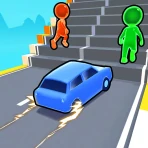
Crumple Zone : Crash & Smash
For Android
I went into Crumple Zone: Crash & Smash expecting a quick racing distraction, and that is exactly where this game makes the most sense. It is a free racing game from Simplyplay built around launching cars into jumps, judging the landing, and accepting that a spectacular mistake can be part of the fun. The appeal is not a long championship structure or a realistic driving simulation. It is the immediate question of whether I can turn a risky jump into a satisfying landing before the run falls apart.
That simple idea gives the game a very particular rhythm. I act, watch the car respond, collect whatever reward the run offers, and then decide whether the result is good enough or whether I want to try again. The next session begins because the previous attempt usually leaves one small doubt: perhaps I could have approached the jump better, held the car straighter, or taken a little more risk. For players who enjoy short arcade sessions, that can be a strong hook.
How the crash-and-retry loop feels in practice
The first action is easy to understand
The strongest part of the design is how quickly the central action communicates itself. I do not need to learn a complicated racing system before understanding the point. A car approaches a jump, and my attention immediately moves to the takeoff, the flight, and the landing. The store summary describes every jump as a calculated risk against nature, and that is a fair way to frame the experience without reducing it to ordinary track racing.
What makes the opening action work is the tension between control and momentum. A safe choice may produce a less dramatic result, while a bolder attempt can create a more memorable payoff or a much worse landing. That gives each jump a small decision attached to it. I am not merely watching a car move forward; I am weighing whether the next input should protect the run or chase a better outcome.
This also makes the game approachable for casual players. Someone looking for a racing game to play in a spare moment can understand the objective almost immediately. There is no need to commit to a full race before discovering whether the basic handling feels enjoyable. A short attempt gives enough information to decide whether the crash-focused style is for you.
Feedback arrives through the car, not just the result
The feedback rhythm is the reason the game can hold attention beyond its first few attempts. A jump creates anticipation, the airborne moment creates uncertainty, and the landing delivers a clear answer. A clean result feels earned because the player has just watched the risk unfold. A poor result is also readable: the vehicle did not settle correctly, the approach was too ambitious, or the timing did not match the jump.
I find this more engaging than a racing game where the only meaningful feedback arrives at the finish line. Here, the important moment happens during the run. The car’s movement turns each jump into a compact lesson. Even when an attempt fails, I can usually identify the moment that caused the problem and carry that observation into the next try.
That learning process is one of the game’s less obvious strengths. I would not treat every crash as wasted progress. Instead, I use failed landings to separate a controllable mistake from a bad gamble. If I repeatedly take the same approach and receive the same poor outcome, the answer is probably not to repeat it faster. The better habit is to change one decision at a time, so the next attempt tells me something useful.
The reward is the feeling of turning risk into control
The reward structure matters here even when the individual run is brief. The immediate prize is not only whatever the game grants after a successful action; it is also the satisfaction of seeing a risky jump resolve in my favor. A landing that looked uncertain a moment earlier can make the whole attempt feel worthwhile.
This is where the game separates itself from a conventional racing title. In a standard racer, I usually measure success by position, lap time, or finishing first. In this experience, the memorable event is the jump itself. The car’s survival, the quality of the landing, and the decision to push further become the meaningful milestones. That narrower focus can be refreshing when I do not want a full competitive race.
There is also a useful trade-off between chasing a better reward and protecting a run that is already going well. Players who always choose the safest option may avoid dramatic failures, but they can also miss the most satisfying moments. Players who always push for the biggest possible result may restart more often. I like that the game naturally creates this personal choice, although people who prefer predictable progression may find the risk-based structure frustrating.
Why another session begins after a reset
The reset is central to the experience rather than an interruption. Once a run ends, I am not returning to a complex campaign with a long checklist in my head. I am returning to a compact challenge that I already understand slightly better. That makes the restart feel inviting when the previous attempt failed for a clear reason.
You may also like

Amazon Kindle: Revolutionizing Digital Reading

Why OLX: Compras Online e Vendas Captivates Shoppers Worldwide

Unpacking the Strategy of Yalla Ludo's Jackaroo Mode

Why eBay's Mobile App Stands Out in Online Shopping

How Fishdom's Puzzle Mechanics Transform Your Aquarium Experience

Block Blast! The Perfect Puzzle for Busy Lives
A realistic everyday use case is a short break between tasks. I can play one attempt while waiting for a meeting, during a commute pause, or when I want something more active than scrolling but less demanding than a full racing game. The short-loop format suits those moments because I do not need to reserve a long uninterrupted block of time. If I have more time, I can continue experimenting with riskier approaches; if I do not, one attempt still feels complete.
The same reset can become less appealing when I want a sense of lasting progression. If your ideal racing game is built around unlocking a large garage, tuning every part, competing through structured events, or improving a precise time over many laps, this is not the substitute I would choose. Its attraction comes from repeating the action with a better decision, not from building a traditional racing career.
Small habits that improve the experience
My first practical tip is to treat the opening attempts as observation runs. Instead of trying to maximize every jump immediately, I watch how much room I have to recover after takeoff. That prevents me from confusing a visually dramatic move with a genuinely worthwhile one. Once I understand the rhythm, I can increase the risk deliberately rather than randomly.
A second useful habit is to judge the landing before thinking about the next reward. It is tempting to focus on the possibility of a bigger result, but the run only benefits if the car remains under control. I get better sessions when I first aim for a stable landing and then decide whether the next jump is the right place to be aggressive.
Third, I avoid changing several things at once after a failure. If I alter my timing, approach, and risk level together, I cannot tell which adjustment helped. Changing one choice per attempt makes the reset more informative. That may sound obvious, but it is especially valuable in a game where the feedback arrives quickly and repeated retries can encourage impatient button presses.
Finally, I recommend stopping after a genuinely satisfying run instead of assuming that another attempt must be better. The loop is designed to make another try attractive, but chasing an improved result indefinitely can turn a fun challenge into a repetitive obligation. The best use of the game is to let the reset invite you back, not force you to continue.
Where it sits among racing alternatives
Compared with a realistic racing simulator, this game is much easier to pick up and far less concerned with detailed vehicle behavior. I would choose a simulator when I want careful braking, circuit knowledge, vehicle setup, and a stronger sense of driving technique. I choose this one when I want the drama of a jump and the quick emotional payoff of a successful or disastrous landing.
Compared with a conventional arcade racer, it also has a narrower identity. A typical arcade racer may give me traffic, opponents, multiple tracks, or a race-long battle for position. Here, the focus is more concentrated on the car’s movement through dangerous jumps. That concentration is a benefit if you like repeated physical challenges, but it can feel limited if you need constant variety or direct competition.
It is also different from stunt games that are primarily about free-form spectacle. The interesting part here is not simply making the biggest crash possible. The action works best when I balance spectacle with control. A run becomes more rewarding when the jump looks dangerous but still feels like the result of a decision rather than pure chaos.
What to expect from the current release
The game is listed as version 0.4, so I approach it as an experience that is still relatively early in its development. That does not automatically make it a poor choice, but it does shape my expectations. I would focus on whether the central jump-and-reset loop is enjoyable now rather than choosing it for the promise of a large, established racing ecosystem.
It is available at no upfront cost, which makes trying the core idea easy. At the same time, optional purchases are listed from $9.99 to $179.99 per item. That is an important consideration for families and for anyone who prefers games with no significant spending pressure. I would keep purchases firmly under control and make sure the person playing understands that free access and optional paid items are separate parts of the experience.
The age classification is Everyone, and the game’s cartoonish crash-focused premise is presented as accessible rather than as a realistic driving simulation. Even so, parents should still make their own decision about whether repeated vehicle destruction fits their child’s preferences. The rating makes it broadly approachable, but it does not replace personal judgment about screen time or spending.
Device compatibility is also fairly approachable: the listed minimum operating system is Android 7.1. That helps older compatible devices remain relevant, although actual smoothness can still depend on the phone or tablet. For the best experience, I would close demanding background apps before playing if the device is older, especially because timing matters more in a jump-based game than it would in a passive title.
Who will enjoy the repeated attempts
I think the best audience is someone who likes short arcade challenges, visible cause-and-effect, and the possibility that a mistake can be entertaining rather than simply annoying. If you enjoy trying a jump again because you believe one small adjustment will change the outcome, the loop has a good chance of working for you.
It is also a reasonable choice for players who want a racing game that does not require learning a large control system. The central idea is focused, and the action can fit around a busy day. The game is especially suitable when I want a quick burst of concentration rather than a long race that demands continuous attention.
I would skip it if your priority is realistic motorsport, deep customization, online competition, or a clearly structured campaign. I would also be cautious if repeated resets make you impatient. The game asks me to accept that failure is part of the entertainment. If I need every attempt to produce steady progress, the crash-and-retry design may feel more repetitive than rewarding.
My verdict on the action-feedback-reward-reset loop
After spending time with it, I see Crumple Zone: Crash & Smash as a focused arcade racing game rather than a complete racing package. Its best quality is the clarity of its loop: make a risky move, read the result, enjoy the payoff when it works, and restart with a better idea. That structure gives the game a reason to exist beyond its short description.
The main limitation is the same quality that gives it character. Because the experience concentrates so heavily on jumps and crashes, players looking for broader racing variety may run out of reasons to continue sooner than they would in a full racer. The optional purchase range also deserves attention before handing the game to a child or allowing unrestricted spending.
Its audience appears to be growing, with over fifty thousand installs, while its average rating sits at 3.7 from around seven hundred ratings. I read that as a mixed but meaningful signal: enough players have found the central idea worth trying, yet the game is not an automatic recommendation for everyone. My own conclusion is similar. I would recommend it to a friend who wants quick, risky stunt-racing sessions and enjoys learning through retries. I would point that friend toward a more traditional racer if they want depth, competition, or long-term vehicle progression.
For the right player, the appeal is simple and honest. One jump creates the problem, one landing supplies the answer, and the reset offers another chance to make the decision better. That is not a substitute for every racing game, but it is a clear, playable loop with enough tension to make one more attempt feel reasonable.
Pros
- Satisfying crash physics make every collision feel entertaining.
- Simple controls let you start smashing cars without a long tutorial.
- Short sessions work well for quick breaks or casual play.
- Vehicle damage and destruction add visual variety to repeated crashes.
- The game encourages experimentation with different crash setups.
Cons
- Repeated crashes can become predictable after extended play.
- Progress may feel limited if you prefer deeper driving mechanics.
- Large collision effects can make smaller gameplay details hard to see.
- Performance may vary on older phones during busy crash scenes.
- The destructive gameplay may not appeal to players seeking realistic racing.
FAQ
What is Crumple Zone: Crash & Smash?
Crumple Zone: Crash & Smash is a physics-based destruction game focused on vehicle crashes, collisions, and spectacular wrecks. You drive into objects, structures, and other obstacles to create as much damage as possible while experimenting with different speeds, angles, and impact points. The appeal comes from watching realistic-looking vehicles deform and discovering how each crash unfolds.
How do you play Crumple Zone: Crash & Smash?
Gameplay is generally built around controlling a vehicle and deliberately causing crashes rather than completing traditional racing laps. Players steer, accelerate, and line up impacts with ramps, barriers, buildings, or other targets. The best results usually come from experimenting with momentum and positioning. It is easy to start, although achieving larger and more satisfying destruction may require practice.
Does Crumple Zone: Crash & Smash require an internet connection?
The game appears suited to short, casual play sessions and may support offline gameplay for its core crash and destruction experiences, but availability of specific features can depend on the version installed and the developer’s current setup. If you want to play without mobile data or Wi-Fi, it is worth checking the Google Play or App Store listing for the latest connectivity requirements before downloading.
Is Crumple Zone: Crash & Smash free to download?
Crumple Zone: Crash & Smash can generally be downloaded without an upfront purchase when offered as a free-to-play title, but the exact monetization model may include advertisements, optional purchases, or both. Before installing, review the store page carefully, especially if the game will be used by children. Pricing, ad frequency, and available purchases can change with future updates.
Is Crumple Zone: Crash & Smash suitable for children?
The game may be appropriate for players who enjoy cartoon-style vehicle destruction and physics experimentation, but parents should still check its official age rating and store description. Crash-focused gameplay is usually presented as fictional and non-realistic, yet advertisements, optional purchases, or online elements may affect suitability. Reviewing device settings and enabling purchase restrictions is recommended for younger players.