Demon Tiles Geometry Songs 2.2
For Android
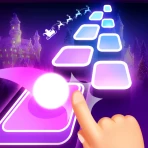
Demon Tiles Geometry Songs 2.2 is a music game built around playable levels and their songs, and I found its appeal easiest to understand when treated as a quick rhythm-focused break rather than a complete music-learning tool. The basic idea is inviting: choose a level, follow the action, and enjoy the track while trying to improve your performance. It is available free of charge, which makes experimenting with it straightforward, especially if you already like short mobile games that depend on timing and repetition.
My experience with this kind of game is that the first few sessions are usually about learning the visual rhythm. You are not simply listening to music in the background; your attention has to stay on the screen while your hands react to what is happening. That creates a small but satisfying loop: attempt a level, notice where your timing slipped, and try again with a better sense of the song. The main attraction is the connection between the music and the repeated play attempts, not a large collection of unrelated game systems.
How the free experience translates into value
The most important practical point is the cost. This is a free game, so there is no purchase price to weigh against the amount of content before installing it. That matters for a casual player who wants to test the rhythm and decide quickly whether the style fits. I would not approach it as a major financial commitment; its value comes from the time it can fill and the enjoyment you get from its levels, not from a paid ownership proposition.
Because it is free, the sensible way to judge it is to ask whether the central activity remains enjoyable after the novelty fades. If you like replaying a song to correct a missed input, the no-cost entry makes that trial worthwhile. If you expect a broad music service, a deep progression system, or the flexibility of a general audio player, the free price does not change the fact that this is a focused game. It should be installed for its play sessions, not mistaken for an alternative to streaming music.
The game comes from BOOT-DARK and sits in the music category. Its store presentation is brief, emphasizing favorite levels and their songs rather than explaining a long list of modes or tools. I see that simplicity as both an advantage and a warning. It keeps the purpose easy to understand, but it also means players who need extensive guidance may have to learn the experience by trying levels rather than relying on detailed instructions.
On Android, the stated minimum operating system is Android 5.0, so the compatibility range includes older devices that cannot run many newer games. That can be useful if you are keeping an older phone for simple entertainment. Even so, compatibility on paper is not the same as comfort in practice. A smaller display, aging touch response, or a device that struggles with animation can make timing-based play less pleasant, so I would test the first few levels before deciding whether it deserves a permanent place on the device.
What the levels offer during an ordinary session
The most convincing use case is a short break. Imagine waiting for an appointment with only a few minutes to spare. A level-based music game gives you something more active than opening a passive playlist, while still being easier to start and stop than a long story game. I could see myself playing one attempt, putting the phone away, and returning later without needing to remember a complicated plot or a large inventory.
There is also value for players who enjoy gradual improvement. A missed note or poorly timed movement is immediate feedback, and repeating the same level can feel productive when the second attempt is cleaner than the first. This is one of the less obvious strengths of the format: the song becomes a memory aid. After a few tries, you begin anticipating changes instead of reacting to every moment from scratch. That anticipation is where the game can become more engaging than its short description suggests.
A useful habit is to play a new level once without chasing a perfect result. I pay attention to where the visual pattern changes and which sections cause hesitation. On the next attempt, I focus on that section instead of treating the whole song as one uninterrupted challenge. This approach reduces frustration and makes the free experience feel more deliberate. It also helps reveal whether the difficulty is enjoyable for you or simply tiring.
Another practical tip is to avoid judging the game from a single rushed attempt. Rhythm play is sensitive to distractions, hand position, and the way you hold the phone. If your first try happens while walking, talking, or dealing with notifications, the result says as much about the situation as it does about the game. A quiet test with both hands available gives a fairer impression of the timing and visual clarity.
Where it differs from ordinary music apps
Compared with a music streaming app, this game asks you to participate. A streaming service is better when I want uninterrupted listening, a large catalog, background playback, or control over playlists. Demon Tiles Geometry Songs is better when I want the song to guide an activity. The distinction is important because someone searching for music discovery will probably be disappointed, while someone searching for a playable music break may find the narrower purpose refreshing.
It also differs from more elaborate rhythm games that build their identity around extensive customization, competitive systems, or a large social layer. I would choose a bigger alternative when I wanted a long-term hobby with many connected goals. Here, the attraction is more immediate: select a level, respond to its song, and decide whether another attempt sounds worthwhile. That limited scope can be a benefit on a crowded phone, but it may feel thin to players who need constant new objectives.
You may also like

Amazon Kindle: Revolutionizing Digital Reading

Why OLX: Compras Online e Vendas Captivates Shoppers Worldwide

Unpacking the Strategy of Yalla Ludo's Jackaroo Mode

Why eBay's Mobile App Stands Out in Online Shopping

How Fishdom's Puzzle Mechanics Transform Your Aquarium Experience

Block Blast! The Perfect Puzzle for Busy Lives
The store rating sits at an average of 3.3 from roughly nine hundred ratings, with a smaller group of written reviews. I read that as a reason to keep expectations measured rather than as a final verdict. The game clearly has enough appeal to attract a substantial audience, but the middling average suggests that the experience will not suit everyone equally. For a free download, trying it yourself is more useful than assuming that either enthusiastic praise or criticism applies to your device and playing style.
Tradeoffs that matter before you settle in
The biggest tradeoff is focus. A game centered on levels and songs can be satisfying precisely because it does not ask you to manage many other systems. At the same time, that focus can become repetitive if you do not enjoy replaying patterns. I would skip it if my preferred mobile sessions involve exploration, narrative choices, construction, or open-ended experimentation. The music theme alone is not enough; you need to enjoy the act of timing your responses.
Another friction point is the learning curve created by limited context. When a game explains its systems lightly, the player has to infer how to approach each level. I usually prefer that kind of discovery in a small casual title, but it can be frustrating if a failed attempt does not clearly show whether the problem was timing, attention, or unfamiliarity with the pattern. The best response is to treat early attempts as practice rather than immediately interpreting failure as evidence that the game is unfair.
Repetition is both the source of its challenge and a possible weakness. Replaying a song can sharpen recognition, but repeated exposure can also reduce the surprise that made the first attempt exciting. My recommendation is to alternate between levels instead of exhausting one track in a single sitting. That preserves some freshness and gives your hands a chance to reset. It is a small workflow change, but it makes a focused rhythm game easier to keep enjoyable over time.
Players should also consider the setting in which they plan to use it. Music-based play is not ideal when you need complete silence, and visual timing games are a poor choice when your attention must remain on another task. I would not use it while crossing a street, commuting in a situation that demands awareness, or trying to listen to someone. Its best environment is a short, stationary break where you can give the screen your full attention.
The current version is 2.1.3, while the requested title refers to Demon Tiles Geometry Songs 2.2. I would pay attention to the version shown on the device when installing, since the version label is the practical indicator of what you will actually play. The important point for a potential user is not to assume that a title reference automatically describes a separate experience; check the installed version and use that as your frame of reference.
Small strategies that improve the experience
First, use the opening attempt as a map. Instead of tapping or moving with panic whenever the pattern changes, identify the rhythm of the section that caused trouble. On the next run, keep your eyes slightly ahead of the immediate action. This is a more reliable way to improve than reacting only after an obstacle or cue is already on top of you.
Second, keep sessions short when accuracy starts to fall. In timing games, frustration can make the same mistake repeat because the player is rushing to recover. Stopping after a few poor attempts and returning later often works better than forcing a long session. The free access makes this approach especially convenient: there is no need to maximize every minute because you paid for a fixed play period.
Third, compare your enjoyment with your goal. If you want a calming soundtrack, the active input may get in the way. If you want a challenge that happens to use songs, the interaction may be exactly what makes it worthwhile. This distinction helps prevent a common disappointment: downloading a music game while secretly expecting a passive listening app.
Who is most likely to get value from it?
I would recommend it to players who enjoy compact rhythm challenges, repeated attempts, and music that gives structure to a game session. It is particularly approachable for someone who wants a free title to test without committing money first. It may also suit owners of older Android phones, since the minimum requirement reaches back to Android 5.0, provided the device still handles touch input comfortably.
It is a reasonable choice for a teenager or adult looking for a quick distraction, and its Everyone content rating makes it broadly suitable from an age-classification perspective. That rating does not guarantee that every player will enjoy the pace or repetition, but it does make the game easier to consider for a shared family device where mature content would be unwelcome.
I would be more cautious about recommending it to someone who wants a rich competitive scene, detailed tutorials, or a deep sense of progression. The concise store description points to a straightforward level-and-song experience, so I would not install it expecting the breadth of a premium rhythm package. Likewise, if your main goal is discovering artists or building playlists, a conventional music app is the better tool.
The game has passed the threshold of around one hundred thousand installs, which shows that it has reached a meaningful audience without making its popularity a guarantee of personal fit. I take that as encouragement to try it, not as a reason to overlook the middling rating. The right question is whether its narrow loop matches the way you like to spend five or ten spare minutes.
My recommendation after weighing the tradeoffs
For me, the free price changes the decision in its favor. I can recommend trying it to a friend who enjoys music games because the cost of testing the central idea is zero, and the likely reward is a handy source of short, replayable sessions. I would describe it as a modest game with a clear purpose, not as an all-in-one entertainment platform.
I would skip it when I want passive listening, a story, or a large progression system. I would also skip it if repeated attempts feel like work rather than improvement. No paid value is being lost by passing on it, and there is no reason to force a free game into a role it was not designed to fill. That is the fairest way to judge its value: free access removes the financial barrier, but it does not remove the need for the gameplay itself to suit you.
Overall, BOOT-DARK’s music game is worth a trial for players who like matching attention and timing to songs. Its strongest quality is the simple loop of learning a level and returning with better anticipation. Its main weakness is the same simplicity, which may leave experienced rhythm-game fans wanting more variety or depth. If you want an inexpensive, low-commitment way to turn a song into a playable challenge, this is an easy one to test; if you want a full music library or a feature-heavy game, choose a different option.
Pros
- Simple tap-based controls are easy for beginners to learn.
- Short song levels make it convenient for quick gaming sessions.
- Bright geometric visuals give the game a distinctive style.
- Increasing speed provides a satisfying challenge for rhythm fans.
- Lightweight gameplay works well on many older mobile devices.
Cons
- Some levels may feel repetitive after extended play.
- Precise timing can be difficult on smaller phone screens.
- The difficulty curve may become frustrating for casual players.
- Visual effects can make fast notes harder to track.
- Progress may feel slow without consistently strong performances.
FAQ
What is Demon Tiles Geometry Songs 2.2?
Demon Tiles Geometry Songs 2.2 is a rhythm-based tile game in which players tap, hold, or follow moving geometric patterns in time with music. Its main appeal is the combination of fast reactions, colorful visual effects, and progressively challenging songs. The 2.2 version is aimed at players who enjoy arcade gameplay, music challenges, and short sessions that can become increasingly demanding as their timing improves.
How do you play Demon Tiles Geometry Songs 2.2?
Gameplay is centered on keeping up with tiles and geometric elements that appear along the track while the music plays. You generally need to tap accurately and avoid missing notes, with the pace and pattern complexity increasing on harder stages. Success depends on rhythm, concentration, and quick finger movement. Before downloading, users should expect an active game rather than a relaxed music player experience.
Is Demon Tiles Geometry Songs 2.2 suitable for beginners?
The game can be accessible to beginners because the basic controls are simple to understand, but later levels may require considerable practice. New players may need time to learn the timing of each song, especially when tiles arrive quickly or patterns become less predictable. It is best suited to users who enjoy retrying difficult stages, improving their scores, and gradually developing faster reflexes.
Does Demon Tiles Geometry Songs 2.2 require an internet connection?
Internet requirements can depend on the specific version, device, and features included by the developer. Core gameplay may work offline if songs and levels are stored locally, while advertisements, updates, leaderboards, or additional content may require a connection. It is advisable to check the permissions and store description before installing, particularly if you plan to play while traveling or with limited mobile data.
Is Demon Tiles Geometry Songs 2.2 free to download and safe to install?
The app may be offered as a free download, although free games can include advertising, optional purchases, or restrictions on certain content. For safety, download Demon Tiles Geometry Songs 2.2 only through a trusted Android or iOS store or a verified developer link. Review the requested permissions, publisher information, ratings, and recent comments before installation, since availability and policies can vary by platform and region.