 [ About Fortnite ]
Why Fortnite Still Makes Every Mobile Match Feel Like a Story
News
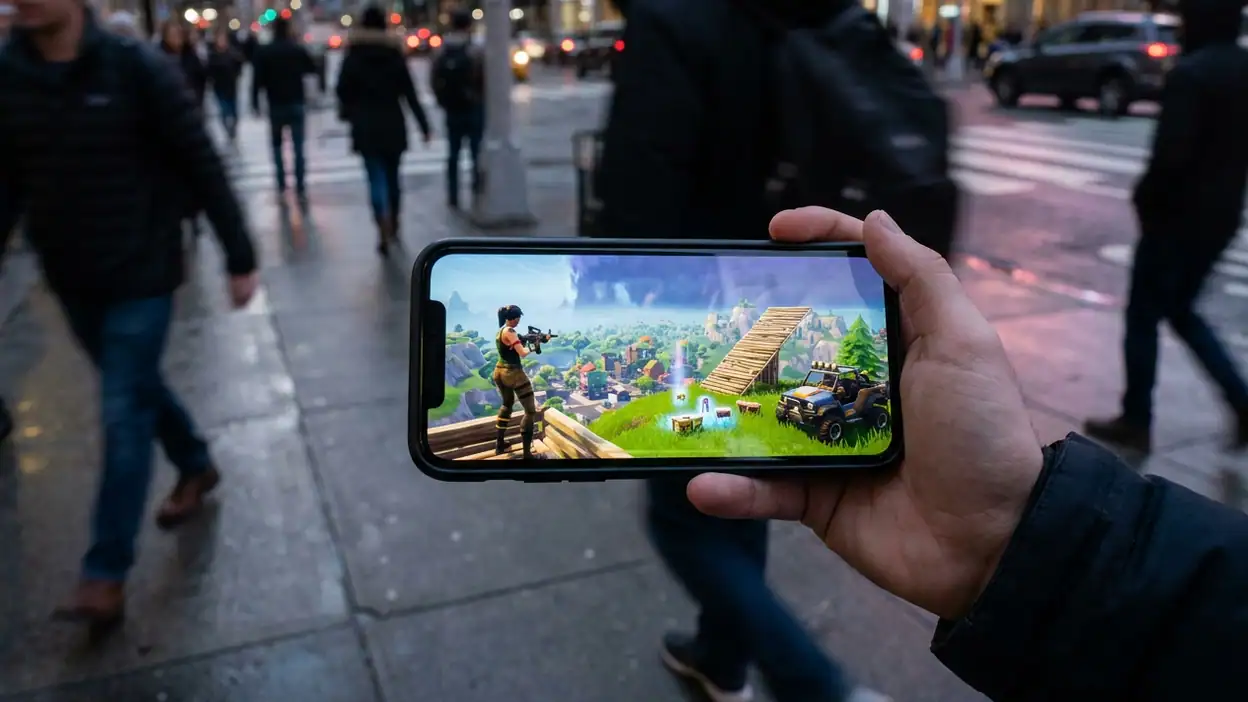
Fortnite is easy to underestimate on a phone. The first match can look like a familiar battle royale: drop from the sky, search for weapons, survive a shrinking storm, and hope to be the last player standing. Then the match starts making demands. Someone is building across a rooftop. A car tears through a quiet village. A chest glows in a ruined room while distant shots turn a simple loot run into a decision about risk. That tension is the reason Fortnite still deserves attention: it is not merely a shooter squeezed onto mobile, but a flexible action game that turns ordinary movement into a chain of urgent choices.
I spent time with the mobile version expecting the usual compromises. Instead, the strongest impression was how quickly it creates a personal story. A match may begin with careful looting and end with a desperate escape through a collapsing zone, a lucky ambush, or an embarrassing fall from a badly planned structure. The controls take practice, the menus can feel busy, and performance depends heavily on the device, but the underlying design remains remarkably good at making each round feel unfinished until the very last second.

Why Fortnite deserves attention
Fortnite has survived because it keeps changing without losing its central promise. The game still understands the basic pleasure of a battle royale: land somewhere dangerous, improve your equipment, read the map, and decide when to fight. Around that foundation, it adds building, vehicles, seasonal twists, quests, social events, creative spaces, and a rotating collection of weapons and locations. The result is a game that rarely feels locked into one rhythm for long.
That variety matters more on mobile than it might on a console. A phone game often has to justify itself in short bursts, yet Fortnite can support a five-minute detour and a full evening of matches. You can play cautiously, chase objectives, explore the island, join friends, or treat every encounter as an excuse to test your aim. The game does not force one correct personality on the player. It gives you a playground and rewards you for learning how its systems collide.
There is also a cultural reason to pay attention. Fortnite is a meeting place as much as a competitive game. Its worlds and events change, its characters carry a strong visual identity, and its social spaces make the app feel larger than a standard multiplayer shooter. You do not need to follow every collaboration or seasonal storyline to enjoy it, but the sense that the island is always moving gives the game a useful pressure. Returning after a break rarely feels like returning to exactly the same place.
The opening hook is immediate and physical
The opening of a match has a clean, satisfying shape. You look over the island, choose a landing point, and commit before you know what the next few minutes will contain. A popular location promises better loot and faster fights. A remote patch of countryside offers time to prepare but may leave you exposed when the storm begins to close. Even before touching the ground, you are making the first meaningful decision of the round.
Landing is more than a transition. It establishes the mood. You might hit a crowded town and hear gunfire before your character has picked up a useful weapon. You might land beside a quiet house, break through the roof, and find enough equipment to feel confident for the first time. The small actions are tactile: opening a chest, swapping a weapon, breaking furniture for materials, collecting ammunition, and checking the horizon. Fortnite understands that preparation feels exciting when danger can interrupt it at any moment.
The first opponent often arrives at exactly the right time. You have just found a better shotgun, or you are still deciding whether to carry healing items, when footsteps appear nearby. The encounter may last seconds. A clean victory gives the match a new direction; a quick defeat sends you back to the lobby with a clear reason to try again. Either way, the game teaches through pressure rather than explanation. You learn the island by surviving its interruptions.
How the core loop feels
The core loop is built from movement, scavenging, positioning, and confrontation. You search for weapons and supplies, read the storm circle, travel toward safety, and decide whether to avoid or pursue other players. Every part feeds the next. Better equipment makes you bolder. A strong position makes a weaker weapon viable. A noisy fight can attract a third party, turning confidence into panic within seconds.
On a touchscreen, this loop works best when the action is allowed to breathe. You can sprint across open ground, slide down a slope, climb, swim, drive, and use the environment to reach a better angle. The island is not a series of shooting galleries. It is a space that asks you to think in routes. A hill may protect you from one direction while making you visible from another. A building may contain valuable loot but become a trap if the storm moves faster than expected.
Building remains the most distinctive part of the traditional Fortnite experience. Gathering materials and raising a wall or ramp can turn a bad position into a survivable one. On mobile, placing structures quickly is harder than it is with a controller or keyboard, especially during a close-range fight. Still, the idea changes the feel of every encounter. You are not limited to the cover the map provides. You can create a temporary answer to danger, then move before that answer becomes predictable.
Players who do not enjoy construction should not assume the game has nothing for them. Modern Fortnite includes modes and play styles that reduce the importance of building, while vehicles and mobility items keep the island active. The important point is that the game supports improvisation. A match does not collapse simply because your original plan failed. You can abandon a fight, steal a vehicle, hide in a structure, or use the storm as cover. The best rounds feel like a series of recoveries.
The shooting itself is accessible but not shallow. Weapons have different ranges, handling patterns, and tactical roles, so the right loadout depends on where you expect the next fight to happen. Close-range weapons reward nerve and timing. Mid-range rifles reward patience and positioning. Long-range options can control space but leave you vulnerable if an opponent closes the distance. On mobile, aim assistance and customizable controls help, but they do not remove the need to read movement and manage panic.
Progression and rewards give every match a purpose
Fortnite is generous with reasons to return. Experience arrives through survival, eliminations, quests, exploration, and smaller objectives that encourage you to try something different. A match is not wasted simply because you finish outside the top ten. You may have completed a challenge, discovered a location, advanced a seasonal track, or learned a useful route through the island.
This is a smart structure because battle royale results can be harsh. Most players lose most matches, and a game that only rewarded victory would exhaust its audience quickly. Fortnite softens that disappointment without pretending defeat does not matter. Winning remains thrilling, but progress continues through ordinary play. The reward system turns experimentation into a sensible choice rather than a distraction from competition.
Cosmetics carry much of the long-term appeal. Outfits, gliders, harvesting tools, emotes, wraps, and other items let players shape a recognizable identity without changing the basic competitive balance. Some rewards are playful, some are dramatic, and some are deliberately strange. The strongest ones work because they become part of the player's memory: the outfit worn during a first victory, the emote used after a lucky elimination, or the glider that makes a familiar drop feel different.
There is a cost to this abundance. The interface can feel like a department store attached to a game, with rotating offers and layered currencies competing for attention. Players who prefer a quiet, focused menu may find the presentation overwhelming. The important distinction is that the store is not the reason the game is fun. The playable systems are strong enough to carry the experience, but the surrounding economy can still make the product feel more commercial than welcoming.
Why sessions are hard to stop
Fortnite creates a particularly effective loop between disappointment and possibility. A defeat is usually short enough to process before the next match is available, and the next match always contains a plausible improvement. Perhaps you landed too aggressively. Perhaps you carried the wrong weapon. Perhaps you ignored the storm, missed a sound cue, or gave away your position while healing. The game makes failure feel specific, which is much more motivating than failure that feels random.
Short sessions help the habit. A quick match can become a longer one because the player is rarely asked to make a large commitment. You can drop in, take a few risks, and leave after the round. Yet the final stages create a different kind of pull. When the player count falls and the safe area tightens, every decision gains weight. A quiet match can suddenly become a tense final circle, and that possibility is enough to make the next queue feel reasonable.
Squads add another layer of momentum. Playing with friends turns survival into shared problem-solving. Someone drives, someone scouts, someone carries healing items, and someone inevitably makes a questionable decision that becomes the story of the evening. Voice communication helps, but even without it, pings and simple teamwork can create a satisfying rhythm. Fortnite is competitive, but it is also good at producing small social dramas that have nothing to do with the final score.
The game also understands surprise. A chest hidden behind a wall, an unexpected enemy in a field, a storm shift that changes the route, or a vehicle appearing at the perfect moment can reset the mood of a match. These events are not all equally skillful, but they prevent the island from becoming a solved routine. You can know the systems well and still be caught in a situation you have not seen before.
Style and identity are part of the reward
Fortnite has a bright, elastic identity that separates it from more serious military shooters. Its locations can move from cozy neighborhoods to futuristic facilities, ancient ruins, forests, beaches, and surreal landmarks without apologizing for the change. The color and animation make the island readable, which is essential on a small screen. You can often understand a location at a glance because its shapes and visual language are clear.
That style does not make the action weightless. A fight still produces the familiar spike of concentration, especially when shields are low and the storm is closing. The contrast is useful. Fortnite can be funny without becoming harmless, and dramatic without becoming grim. A ridiculous outfit can sprint across a battlefield, but the player wearing it still has to make serious decisions about timing and cover.
The audio design supports that identity. Chests, footsteps, weapon fire, vehicles, and environmental sounds create a directional map of danger. Headphones make the experience more informative, but even casual players can learn to recognize the difference between nearby movement and distant combat. Sound is one of the quiet ways Fortnite turns the island into a living space rather than a flat arena.
On mobile, visual quality depends on hardware and settings. A newer device can make the island look impressively sharp and keep movement smooth, while older phones may need reduced detail or frame-rate compromises. Battery drain and heat are real concerns during longer sessions. Fortnite is demanding, and that demand should be part of the installation decision. A stable connection and a device with enough storage make a noticeable difference to the experience.
Who Fortnite is perfect for
Fortnite is ideal for players who enjoy action with room for improvisation. If you like shooters but want more mobility, more environmental interaction, and less dependence on fixed lanes, it is an easy recommendation. It also suits players who enjoy collecting cosmetics, completing objectives, and watching a game world change over time. You do not have to be the most accurate player in the lobby to find a satisfying role.
It is especially good for people who like games that generate stories rather than simply record victories. A round can be memorable because you survived with a basic weapon, rescued a teammate under fire, escaped by car, or won a fight after building a desperate tower. Those moments are not scripted, which makes them feel personal. The game gives you enough systems to create situations worth retelling.
It is less suitable for anyone who wants a calm, predictable mobile game. The opening can be chaotic, the competition can be unforgiving, and the interface takes time to learn. Players who dislike live-service updates may also find the constant changes tiring. Fortnite asks for attention. It is not a game you play passively while waiting for another app to load.
Where it frustrates
The biggest obstacle is control. Touch input can be surprisingly capable, but it is still touch input. Managing movement, camera control, aiming, inventory, building, and quick item swaps with fingers requires practice. A player who already knows Fortnite from another platform may feel temporarily clumsy on mobile, while a newcomer has to learn both the game and the control layout at once.
Customization helps, and external controller support can make the game feel more comfortable for some players, but neither option erases the learning curve. The screen can become crowded during a tense fight, and a misplaced tap can cost a match. I also found that the best control setup depends on personal habits rather than one universal arrangement. It is worth spending time in low-pressure modes before judging the mobile version.
Matchmaking and performance can introduce their own irritations. Connection problems, frame drops, heat, and long downloads are not theoretical issues on a phone. They can change the outcome of a fight or make a promising session feel like maintenance. Epic has continued to improve the mobile experience, but the game remains more demanding than lightweight alternatives such as Temple Run 2: Endless Escape or slither.io.
There is also the emotional friction of battle royale design. You can spend several minutes gathering equipment and positioning carefully, only to lose to a player you barely saw. That structure is exciting when the loss teaches you something and frustrating when it feels sudden. Fortnite cannot remove that tension without removing much of its identity. Players need to accept that preparation is not protection, only a better chance.
How it compares with genre favorites
Compared with Temple Run 2: Endless Escape, Fortnite is far less immediate and far more demanding. Temple Run gives you a clean reflex loop: run, turn, jump, collect, and try to beat your previous distance. Fortnite asks you to interpret a changing environment and make choices with incomplete information. One is perfect for a quick solo burst; the other rewards longer attention and social play.
slither.io has a similarly simple premise but a much lighter commitment. Its pleasure comes from steering well, growing steadily, and avoiding a sudden collision. Fortnite shares that tension between growth and vulnerability, yet adds equipment, terrain, objectives, and team tactics. If slither.io is a compact arcade duel, Fortnite is a full match built from many overlapping systems.
Sniper 3D: Gun Shooting Games focuses on controlled aim and clearly framed missions. It can be satisfying when you want a direct target and a short objective. Fortnite is less tidy. The target may be another player, the storm, a quest, or simply the safest route across the map. Its action is harder to predict, but that unpredictability is exactly what gives the best matches their character.
Among Us is another useful contrast. Both games can become social experiences, but Among Us builds its tension around discussion, suspicion, and deception. Fortnite builds it around movement, equipment, and split-second combat decisions. A group may enjoy both because they create different kinds of stories: one asks who can be trusted, while the other asks who can survive the next encounter.
Fortnite's closest competition is not necessarily a single rival. It competes with the player's entire collection of quick mobile distractions. Its advantage is breadth. Few games can offer a short solo match, a coordinated squad session, a creative detour, and a constantly changing world inside the same app. Its disadvantage is equally clear: that breadth brings a heavier download, more complex menus, and a larger demand on time and hardware.
Why it is worth installing now
Fortnite is worth installing now if you want a mobile action game with a strong sense of place and a reliable supply of new situations. The core match structure remains understandable even as the surrounding content changes. You can begin with a simple goal, such as learning a landing spot or surviving one more circle, and gradually discover the deeper systems at your own pace.
The game is also more welcoming when approached as a collection of modes rather than a single test of competitive skill. If building feels intimidating, try a mode where it matters less. If battle royale feels too serious, explore creative experiences or play with friends. If the live-service noise is distracting, focus on the island, the movement, and the basic satisfaction of improving one decision at a time.
Most importantly, Fortnite still produces moments that simpler games cannot. The combination of a shrinking play area, limited resources, player-made cover, unpredictable encounters, and expressive movement creates a rhythm that is difficult to copy. The reward is not only a victory screen. It is the feeling that you solved a messy problem under pressure, even if the solution was a lucky one.
New players should give the game several matches before forming an opinion. The first rounds can feel crowded with information, and the controls may seem awkward until muscle memory develops. Once the interface fades into the background, the island becomes easier to read. You start noticing the sound of nearby movement, the safest route through a valley, the difference between useful cover and a dead end. That is when the game begins to reveal its depth.
Final verdict
Fortnite remains one of the most complete action games available on mobile because its hook is simple but its possibilities are not. You land, loot, move, fight, and survive, yet every match bends that structure into a different story. The building system, evolving island, flexible modes, social play, and cosmetic progression give it a longer life than a standard shooter, while the short match format keeps the first step easy.
It is not flawless. Touch controls require patience, the app demands capable hardware, the interface can be noisy, and battle royale defeats can feel brutally abrupt. Those weaknesses matter, particularly for casual players who want instant comfort. But they do not erase the central achievement: Fortnite makes a mobile screen feel like a place where plans can fail in interesting ways.
If you want a lightweight reflex game, Temple Run 2: Endless Escape or slither.io will get you moving faster. If you want focused shooting or social deduction, Sniper 3D: Gun Shooting Games and Among Us serve different moods. Install Fortnite when you want the bigger commitment, the louder surprises, and the chance that one ordinary match will turn into a story you remember. It remains a demanding game, but its reward is equally substantial: a battle royale that keeps finding new ways to make the next drop feel worth taking.